

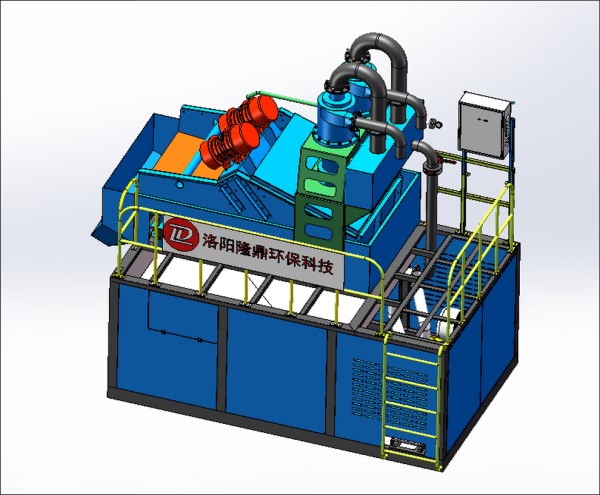
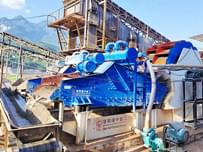
The cyclone sand washing plant is independently developed by LZZG and combined with the actual situation of the sand washing industry, such as the sand field, mineral processing plant, etc., and has the world advanced level. Cyclone sand washing plants are widely used in sand and aggregate cleaning, mud purification, coal slime recovery, artificial sand making, gravel aggregate, glass and ceramic raw materials. Structure Cyclone sand washing plant is composed of hydrocyclone, dewatering screen, cleaning box, return box, slurry pump, vibration motor. Working principle Cyclone sand washing plant working process: The slurry pump conveys the sand-water mixture at high pressure to the hydrocyclone separator. The fine-grained material concentrated by high-pressure centrifugal classification is transferred to the dewatering screen through the grit nozzle. After high-frequency dehydration through the vibrating screen, the fine sand is effectively separated from the water. It is discharged into the belt by the high-frequency dehydration screen. Features 1. It can effectively reduce the loss of fine particles and solve the problems of high fineness modulus and low stone powder content in the finished product. 2. Fine particulate materials with a maximum recyclable discharge of 95% have unmatched technical and economic advantages of other equipment. 3. The operation is…
read more >>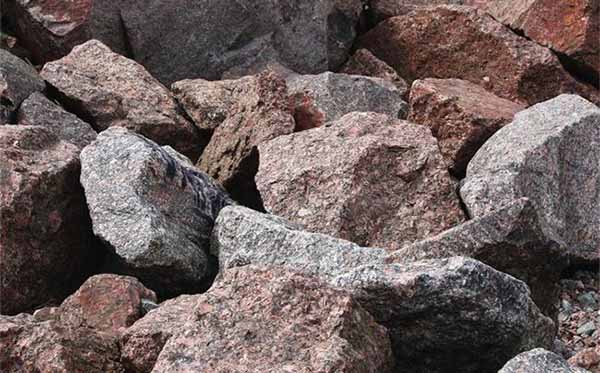
Granite is a common processing material on sand and gravel production lines, with high hardness, high silicon content, and high processing cost. Therefore, the reasonable configuration of granite washing plant can not only meet the production needs but also reduce the investment cost. Granite washing plant process Although the equipment configuration of the washing plant is different, the production process is roughly the same. The large granite raw materials are fed into the jaw crusher by the feeder evenly through the hopper for coarse crushing. The coarsely crushed stone is sent to the next section of the crushing process by conveyor. The medium and finely crushed stones are sent to the vibrating screen by a belt conveyor for sieving. The stones that meet the requirements of the particles are sent to the finished product pile by the finished belt conveyor. The material that does not meet the requirements of the granules is crushed again by the belt conveyor to form a closed circuit for many cycles. Finally, the part that meets the particle requirement is sent to the sand washing machine for washing and dewatering. Granite washing plant equipment configuration 1. Vibrating feeder, jaw crusher, impact crusher, vibrating screen, sand washing machine, belt…
read more >>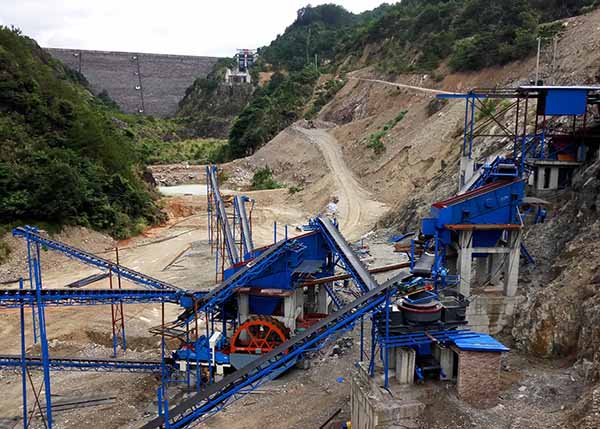
River stone washing plant is a complete production line composed of crushing equipment, vibrating feeder, vibrating screen, and sand washing machine, which processes large pieces of sand and gravel materials into high quality finished sand and gravel materials with different sizes. The river stone washing plant is widely used in construction projects, building material processing projects, large-scale cement production, and concrete production. Equipment configuration of river stone washing plant The bulk raw materials in the hopper are transported to the jaw crusher by vibrating feeder for crushing and then enters the hammer crusher for secondary crushing. Then the crushed sand and gravel are screened by vibrating screen to obtain several finished products with different specifications. This large-scale production line is used in many large-scale production projects because of its large output and high production efficiency. The process design of river stone washing plant 1. Site survey stage. In the early stage of building the sand and gravel production line, technicians need to carefully survey the situation on the site. For sites that do not meet the construction requirements, they must be leveled or replaced in time. 2. Equipment selection stage. After detailed communication with the customer, according to the materials,…
read more >>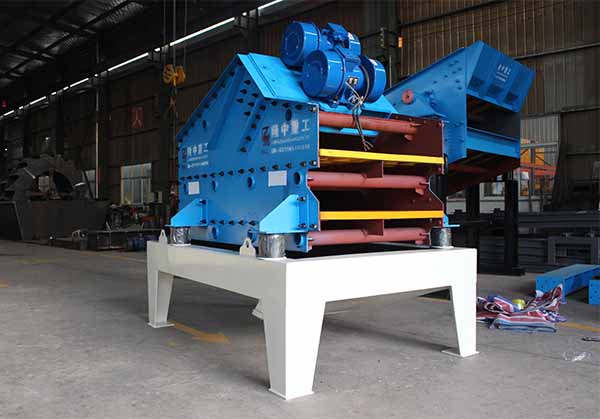
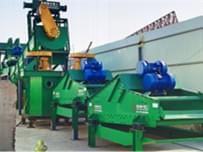
The double deck dewatering screen can be further sieved on the basis of general single deck dewatering sieve to obtain two materials with different particle sizes. Layer-by-layer screening improves the quality of the finished sand and satisfies the customer's needs for different materials. The double-layer dewatering sieve is an innovation of LZZG on the basis of the single-layer dewatering screen. Double dewatering screen, big capacity dewatering screen adopts double electrode self-synchronization technology. The universal eccentric block and adjustable amplitude. It is mainly composed of a screen box, a vibrator, a support system, and a motor. The two coupling vibrators are driven by the tape coupling to perform reverse operation simultaneously. The centrifugal force generated by the two sets of eccentric masses is superimposed on the component of the vibration direction, and the reverse centrifugal force cancels out, thereby forming a single excited vibration along the vibration direction. Make the screen box reciprocate linearly. When is it necessary to use a double-layer dewatering screen? As a dewatering screening device, the screen panel is installed on the dewatering screen with fixed screen size. In the sand and gravel plant, the finished sand obtained by wet sand making has large and small particles,…
read more >>
The size of sieve for sand washing required in the washing process greatly improves the production efficiency, finished product quality, and output. Screening is very important in the sand washing process. The screening process of materials in ordinary vibrating screens and resonance screens, probability screens, and equal thickness screens are based on the principle of probability. Extra fine sand: fineness modulus is 1.5-o.7, average particle size is below o. 25mm. Fine sand: fineness modulus is 2.2-1.6, the average particle size is 0.35-o.25mm. Medium sand: fineness modulus is 3.0-2.3, the average particle size is 0.5-0.35mm. Coarse sand: fineness modulus is 3.7-3.1, average particle size is bigger than o.5mm. Sand and gravel materials usually make periodic movements in various sieving machines. In each cycle of the material moving on the screen surface of the sand washing machine, various particles smaller than the screen hole size pass through with a certain probability. Since the material to be sieved is usually composed of particles with different particle sizes, a part of the material to be sieved is left on the sieve surface after being screened by the sand washing machine. The probability of the material passing through the screen is related to the particle…
read more >>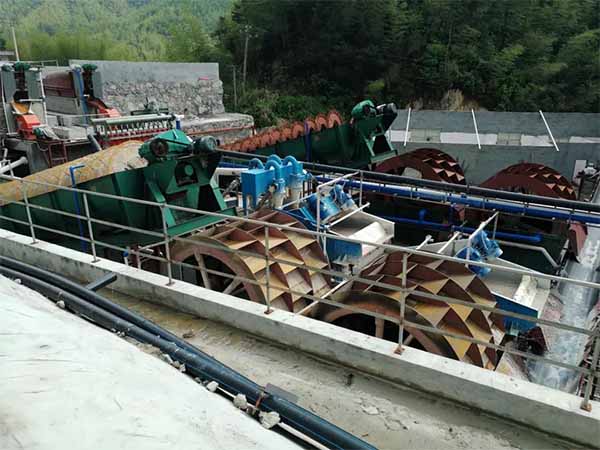
The kaolin washing process is generally used for soft kaolin and sandy kaolin. The raw kaolin ore is broken up under the high-pressure impact of water or pulped by tamping. The slurry is pumped into the screw classifier to remove sand and then sorted with a hydrocyclone. The sorted coarse concentrate is separated into paint grade and filler grade products by the horizontal spiral centrifugal classifier. Coating grade products are shipped out after magnetic separation, bleaching, pressure filtration, drying, and packaging; filler grade products are shipped out after pressure filtration, peeling, drying, and packaging. Main processing technology of kaolin Kaolin processing technology generally includes beneficiation purification, ultra-fine crushing, calcination, and surface modification. The original kaolin ore contains kaolinite minerals as the main components, and there are a small number of impurities such as montmorillonite, quartz, and illite to varying degrees. Therefore, kaolin used as a mineral filler must be beneficiated and purified. The beneficiation process of kaolin depends on the type of ore. Different beneficiation and purification processes are adopted for soft kaolin, sandy kaolin, and hard kaolin. Kaolin washing process Pulping The original ore is added with water and dispersant according to the set concentration and is pulped in a…
read more >>
The pretreatment of washing aggregates is a prerequisite for the sand washing machine to be able to complete the sand washing safely, efficiently, and smoothly. But the most important thing is that we have to know what is the pretreatment before starting the sand aggregate washer. 1. Debris cleaning Before starting the sand washer, be sure to clean up the debris, especially inside the sand washer, around the work site, and the transmission part. 2. Venue layout The selection of a sand washing machine work site is very important. It is necessary to ensure the hardness of the installation ground and not too close to the water source. Therefore, generally responsible manufacturers will design a reasonable site layout depends on the customer’working site. 3. Tool reserve Commonly used tools must be prepared to repair in time when the sand washer fails. 4. Equipment cleaning and maintenance After the stone washer has been in operation for a period of time, it is necessary to carry out regular inspections and regular cleaning to ensure the normal operation and at the same time. 5. Check the tightness of the bolts and fasteners of the sand washer to ensure that there are no loose points. 6. Cooperate…
read more >>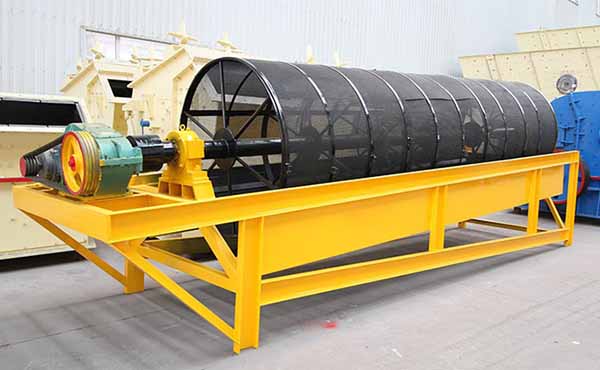
The drum screen in Malaysia adopts a round-rolling screen drum to ensure that the material flow continuously rolls, slides, and separates among the multi-turn spiral blades in the screen barrel to achieve the screening purpose. The drum screen is mainly composed of motor, reducer, drum device, frame, sealing cover, inlet, and outlet. It is widely used for sand and gravel grading in rivers, construction, ore, and coal. Fedding size: 50-150mm Processing capacity: 12-200t/h Applications: for the classification of solid and powdery materials. Screen mesh size: 60-200 mesh screen Working principle The motor is connected to the roller device via a reducer through a coupling and drives the roller device to rotate around its axis. During work, when the material enters the roller device, the tilting and rotation of the roller device cause the material on the screen surface to turn and roll, so that the qualified material is discharged through the outer cylindrical screen, and the unqualified material is discharged through the end of the roller. It overcomes the problem of sticking and blocking of the screen when screening the wet materials and improves the output and reliability of the screening system. Features 1. Adopting the rolling conveying principle. Small friction coefficient,…
read more >>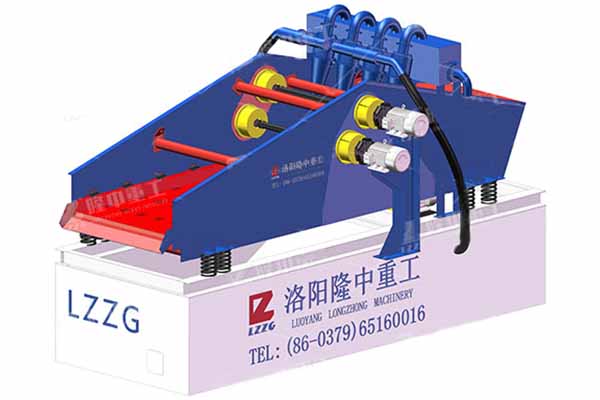
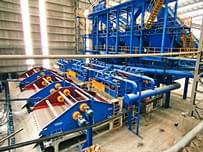
XSX screening washing and dewatering system are optimized on the basis of the general dewatering screen, and a 45-degree overflow screen plate is added to the rear of the screen to help effective dewatering and screening. It plays a key role in the sand production line and ore processing plant and will play an increasingly important role in the future. Working principle The materials are evenly fed to the back of the screen surface and cleaned in the trough-shaped structure. With the continuous increase of materials and the vibration of the screen surface, materials continue to enter the dewatering screen surface of the front end of the screen and complete the dewatering and screening operations under the action of vibration. The fine sand lost in this process is recovered by the fine sand recovery device to maximize the use of resources. Advantages 1. Multiple functions. Cleaning, screening, dehydration, and fines recycling operations all be completed on one equipment. 2. The rear of the screen adopts a polyurethane plate structure to form a water reservoir, and an additional weir is added to extend the material cleaning time and the material cleaning effect is better. 3. The overall sieve surface is longer, which…
read more >>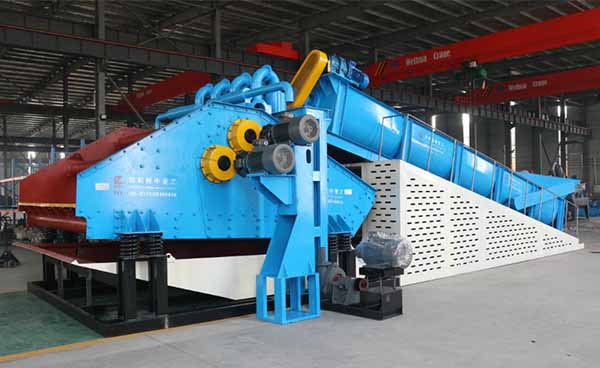
New technology sand wash equipment is a sandstone cleaning system developed according to environmental protection requirements, which can effectively remove impurities covering the surface of sand and stone, thereby improving the comprehensive utilization rate of sand. Compared with the traditional sand washing equipment, the new tech sand washing machine has a full range of specifications and models and large processing capacity. For the cleaning and processing of large, medium and small projects all can meet. It also can be customized depends on your requirements. Sand washer plays a great role in the quality control of finished materials. It has been widely used in washing, grading, and impurity removal in industries such as quarry, metallurgy, building materials, hydropower, mine stone, etc. The material falls vertically from the upper part of the machine into the impeller rotating at high speed. Under the action of impeller rotating, it collides with another part of the material flowing around the impeller in an umbrella shape. A vortex is formed between the impeller and the casing, and they are stirred, rubbed and cleaned many times. After being picked up by the impeller, it enters the vibrating screen for screening and dewatering. The wastewater is discharged directly from…
read more >>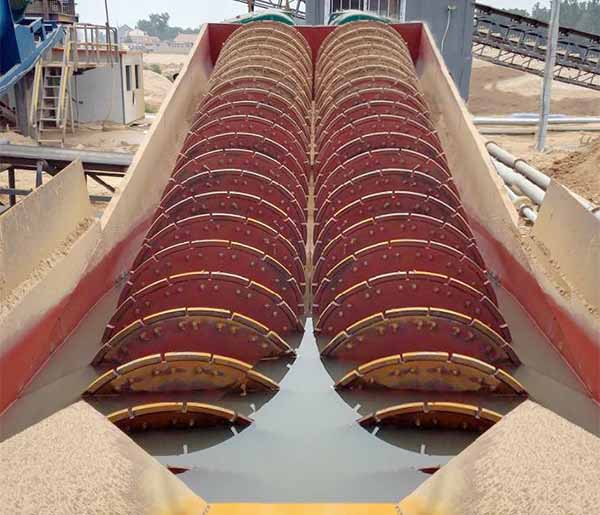
Sand washer is especially suitable for washing coarse and fine-grained materials for road construction and building construction. With the continuous upgrading of various sand washing equipment, some industry standards for the purchase and processing of sand and stone have also begun to rise. There are not only various grades of gravel grading, but also strict requirements on the impurity content of gravel. LZZG new tech compact sand washers are popular in road construction. Sandstone is one of the main components of concrete and mortar. It is generally divided into natural sand and artificial sand. Rock particles formed by the action of natural conditions and having a particle size of less than 5 mm are called natural sand. Artificial sand is machine-made sand, which refers to rock particles with a particle size of less than 4.75mm made by mechanical crushing and sieving. However, it does not contain soft rock and weathered rock particles. The specifications of sand can be divided into four types: extra fine, fine, medium and coarse according to different fineness modulus. The larger the fineness modulus, the coarser the sand. The fineness modulus of ordinary concrete sand is in the range of 3.7-1.6, medium sand is suitable, or coarse…
read more >>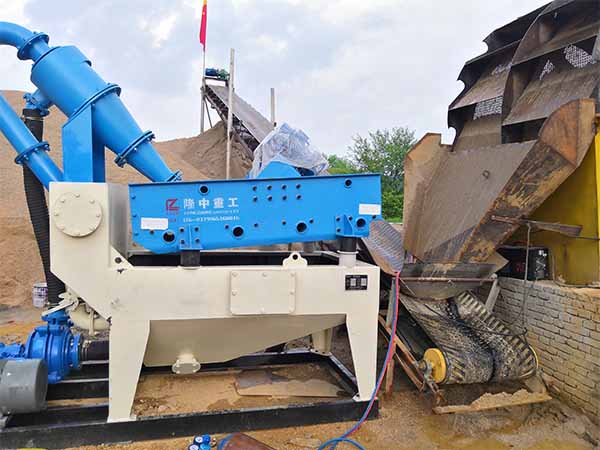
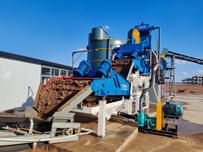
The sand recycling system with single slurry pump is a unit developed for fine recovery, dewatering, desliming de-intermediation and de-mudging of slurry materials, which can effectively solve the problem of fine sand lost. Most of the sand production lines use a wet production process, resulting in the loss of fine sand below 0.16mm. The loss of fine sand not only causes serious losses, but also seriously affects the gradation of the sand, resulting in unreasonable gradation and coarseness of the fineness modulus, which greatly reduces the purity and quality of the manufactured sand. At the same time, excessive fine sand discharge will also cause environmental pollution. SAND RECYCLING SYSTEM FUNCTION 1. Reducing fine sand loss. The fine sand recovery system can efficiently recover a large amount of fine sand lost in the waste water discharged from the sand washing machine, which greatly increases the output of the sand and stone plant and brings greater economic benefits for the enterprise. 2. Improving finished products quality. The large amount of fine sand loss in sand washing production line will make sand and stone fineness modulus imbalance, which seriously affects the improvement of sand and stone quality.Therefore, the reasonable fine sand recovery machine…
read more >>


Copyright © 2015 - 2026 Luoyang Longzhong Heavy Machinery Co., Ltd. Website Map | Privacy policy | Contact Us




Inquiry