

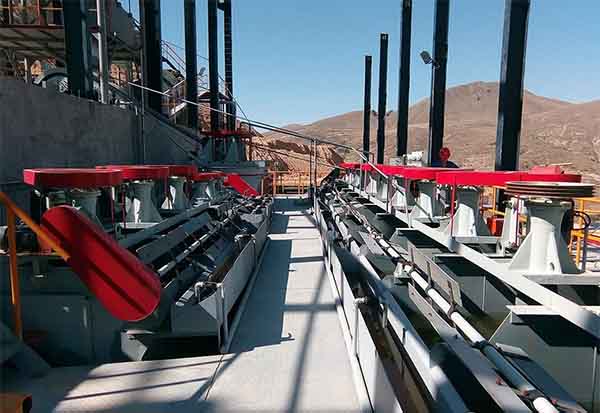
Antimony gold mine is an important part of gold resources. Its distinctive feature is that gold is encapsulated in fine particles or impregnated in sulfide, which is a kind of refractory gold ore. The common antimony gold ore beneficiation methods mainly include flotation, pretreatment, and enhanced leaching. 1. Antimony gold ore flotation method The antimony gold ore flotation method is mostly used to process ores whose antimony minerals are not the carrier minerals of gold. Its essence is the flotation separation of antimony minerals and gold-bearing minerals such as sulfur and arsenic. It can avoid complicated pretreatment links, and at the same time obtain by-product antimony concentrate, and the cost is relatively low. A. Mixed flotation The mixed flotation process is relatively simple. However, it is difficult to suppress the floating gold-bearing minerals such as sulfur and arsenic, causing some minerals such as sulfur and arsenic to be mixed into the antimony concentrate, which affects the quality of the antimony concentrate. B. Priority flotation The preferential flotation method can be divided into two processes: preferential flotation of gold-loaded minerals such as arsenic and sulfur, and preferential flotation of antimony. Most antimony gold ore flotation plants often use the preferential antimony flotation process. The…
read more >>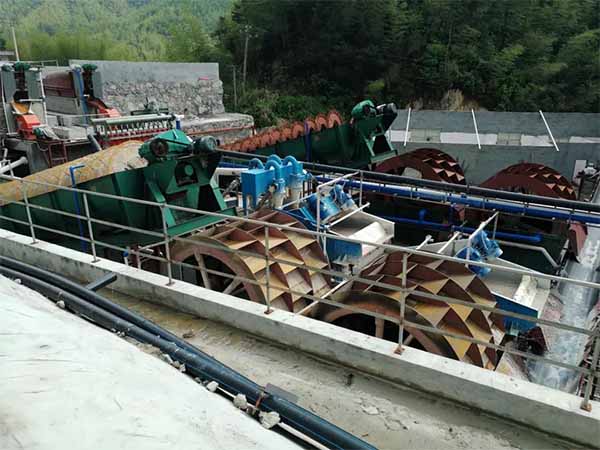
The quartz sand process is a separation technology used to remove small or trace impurities in quartz sand to obtain refined quartz sand or high-purity quartz sand. It mainly includes the impurity removal process of quartz sand, the purification process of quartz sand, the classification process of quartz sand, etc. The quartz sand production line is mainly composed of a vibrating screen, spiral classifier, scrubbing machine, magnetic separator, spiral chute, pickling machine, dryer, linear screen, thickener, filter press, and other equipment. Different equipment is combined to meet different process requirements. Quartz sand process 1. Quartz sand removal process A. Crushing, grinding, coarse sieving The natural quartz sand is crushed into small pieces with a crusher, and then wet grinding is performed with grinding equipment to grind the small pieces of quartz into finer-grained quartz sand. The wet grinding process can not only eliminate the dust generated in the grinding process, but also make the quartz particles rub against each other, and promote the dissociation of the impurities attached to the quartz surface from the quartz particles. Then the grinding product enters the classification process. The coarse particles >20mu are returned to the grinding equipment for regrind, and the quartz sand <20mu enters…
read more >>
Tailings with different particle size distributions should adopt different dry tailings drainage processes, and strive to reduce the area and investment as much as possible on the premise of improving the dry drainage effect. According to different particle sizes, tailings can be divided into coarse-particle tailings, medium-fine-particle tailings, and ultra-fine-particle tailings. The ore properties, mineral composition, specific gravity, concentration, particle size, and distribution of these tailings are different. Choose an appropriate dry tailings discharge process to dewater the tailings through multiple stages to form tailings slag with small water content, so that it can be stacked, stored, or transported in the form of dry slag. 1. Dry discharge process of coarse-grained tailings Coarse particle tailings slurry refers to solid particles> 0.075mm, which does not require high quality recycled backwater. The dry discharge process often adopts a two-stage concentration-dehydration scheme, namely cyclone + dewatering screen + thickener. The beneficiation tailings are fed into the cyclone, and the overflow of the cyclone is fed into the thickener. The overflow water of the thickener is returned to the production circulating water for reuse. The underflow and concentrated underflow of the cyclone is fed into the dewatering screen. The material on the dewatering screen is discharged dry,…
read more >>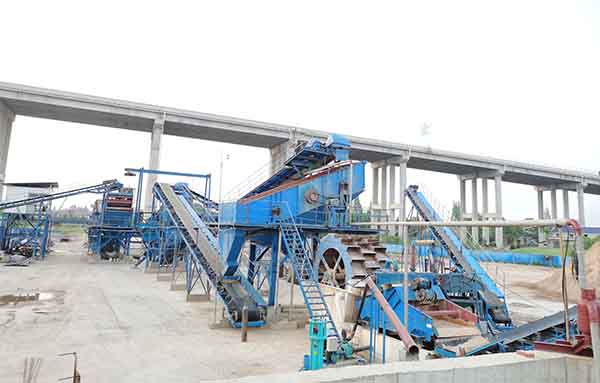
The mountain sand crushing production line can produce two kinds of materials of stone and sand. Since multiple specifications of finished products are produced at the same time, the hourly output of a single specification of finished materials will be reduced, but the total hourly output is consistent with the design of the production line. The key to producing multiple materials at the same time lies in the screening function of the vibrating screen. The multi-layer screen can classify the finished product while screening. Plan one: two-stage crushing Equipment configuration: ZSW490×110 Vibrating Feeder, PE750×1060 jaw crusher, PYB1750 cone crusher/PF1315 impact crusher, 3YK1854 vibrating screen, 3121 sand washing machine, belt conveyor Finished product specifications: 0-5,5-10,10-20,20-30mm Advantages: 1. The two-stage crushing can realize the crushing of stones and finely crush of machine-made sand at the same time. The broken ratio is greater. It is not easy to be damaged, and the purchase and construction price is lower. Plan description: After cone crushing or counterattack crushing, multi-layer screens are arranged. After screening and grading the finished stones and sand, they are discharged and stored separately. Plan two: three-stage crushing Equipment configuration: ZSW490×110 vibrating feeder, PE750×1060 jaw crusher, PYB1750 cone crusher/PF1315 impact crusher, HVI1032 sand making machine, 3YK1854…
read more >>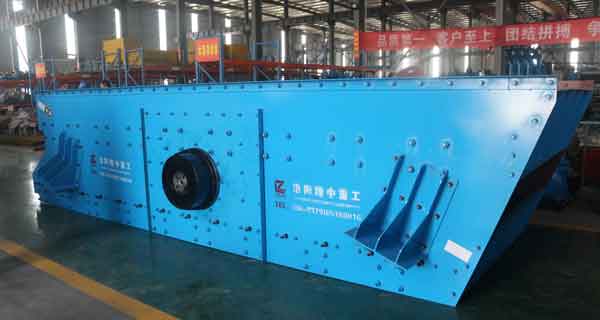
After the long-term operation, the vibrating screen is prone to breakage of the beam, track beam, and side plate. The cross beam and track beam can be solved by replacement. Cracks on the side plates can be welded. However, since the welding stress cannot be eliminated, cracks will appear again soon. The following mainly lists the treatment methods for the cracking of the side plate of the vibrating screen. Difficulties in the treatment of side plate cracks The vibrating screen frame structure is riveted together by riveting bolts. If you want to replace the cracked side panel, you have to remove hundreds of riveting bolts on the side panel and rivet again, which is too much work. There is neither venue nor time to do this. If only a simple welding process is carried out, the welding stress of the side plate cannot be eliminated. Not only will it not achieve good results under vibration conditions, but it will also aggravate the extension of cracks or appear other new cracks. Treatment technology of side plate cracks The main technology of side plate processing is welding requirements, welding seam processing, and adding reinforcement plates for riveting. Necessary cleaning, shaping, and groove welding of side…
read more >> Flotation is a beneficiation method widely used in current concentrators. Different ore properties determine different flotation processes. According to the number of sections of the flotation process (the number of combined ore grinding and flotation), the common flotation process can be divided into a stage grinding and flotation process and a stage grinding and flotation process. What is the difference between these two flotation processes? 1. One stage of grinding and floating process After grinding once, the ore has been ground to a particle size that can be floated. And any flotation product does not need to be re-grinded, it is called a one-stage grinding and flotation process. The one-stage grinding and flotation process is suitable for ore with a relatively uniform distribution of useful minerals, relatively coarse particle size, and not easy to silt. 2. Stage grinding and floating process If a certain flotation product needs to be re-grinded and re-selected one or more times, it is called the stage grinding and flotation process. The common stage grinding and floatation process is mainly the two-stage grinding and floatation process, including the concentrate regrinding process, medium ore regrinding process, and tailings regrinding process. The stage grinding and flotation process is mostly used to…
read more >>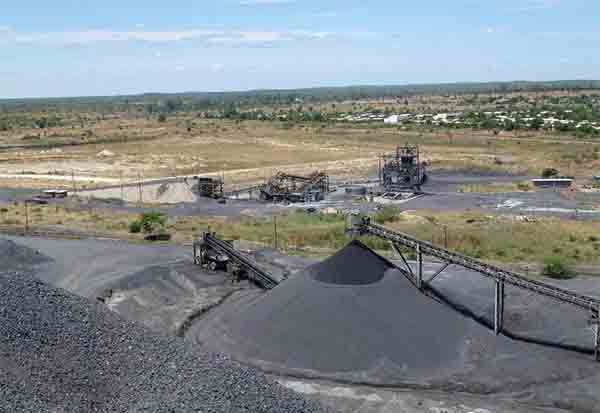
The common tailings re-selection processes mainly include flotation, gravity separation, and magnetic separation. The equipment used in different tailings re-selection methods is also different. The commonly used tailings re-selection equipment are flotation machine, gravity separation machine, and magnetic separation machine. 1. Re-selection of tailings---flotation equipment The flotation method is mostly used for difficult-to-treat tailings in tailings reselection. The commonly used flotation equipment is mainly the mechanical agitating flotation machine and aerated agitating flotation machine. A. Mechanical agitated flotation machine The mechanical stirring flotation machine uses a mechanical stirrer to realize the aeration and stirring of the slurry and belongs to the air self-suction flotation machine. In the process of tailings re-election, the intermediate product returns generally without sand pumping. Generally, mechanical agitation flotation machines mainly include SF flotation machines, JJF flotation machines, and BF flotation machines. SF type flotation machine and JJF type flotation machine are mostly suitable for roughing and sweeping operations of small and medium-sized tailings reconcentration plants. The BF flotation machine is mostly suitable for roughing and beneficiation operations in small and medium-sized tailings reconcentration plants. B. Aerated agitating flotation machine The aerated stirring flotation machine belongs to the external air supply type flotation machine. The flotation machine can be…
read more >> The effective separation of feldspar and quartz has always been a major difficulty in the mineral processing industry. In the production process, flotation is often used for the separation of feldspar and quartz. According to the different pulp media, there are three main methods for flotation separation of feldspar and quartz, namely alkaline flotation, acid flotation, and neutral flotation. 1. Alkaline flotation Separation of quartz and feldspar in alkaline pulp with a pH value of 11-12, alkaline earth metal ions as active agent and alkyl sulfonate as a collector, reverse flotation preferentially floats quartz. At the same time, adding a suitable non-ionic surfactant can significantly increase the recovery rate of quartz. Under alkaline conditions, the neutral complex formed by the metal ion and the alkyl sulfonate plays a key role. These neutral complexes and free sulfonate ions are combined together to be adsorbed on the surface of the quartz, and under high alkali conditions, a hydrated layer is formed on the surface of feldspar. 2. Acid flotation The acid flotation method is to preferentially flotation feldspar using an anion and cation mixed collector at a pH of 2-3 acid slurry. According to the different chemicals used, the method can be divided into fluorine flotation…
read more >>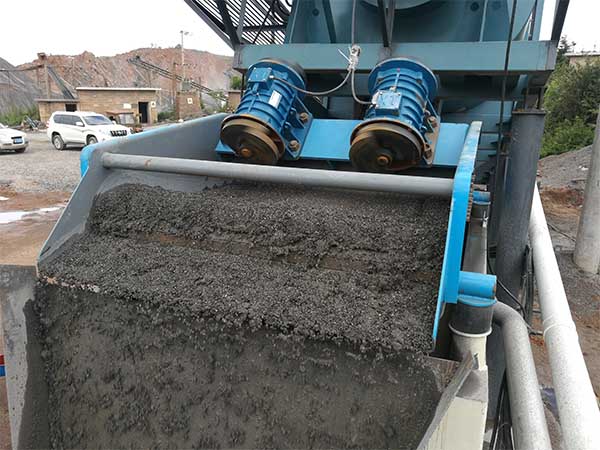
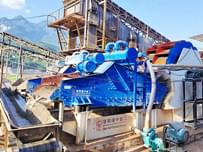
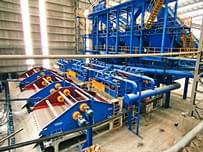
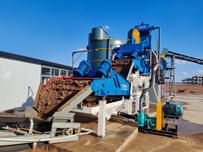
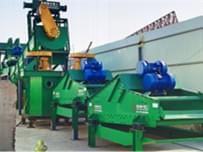
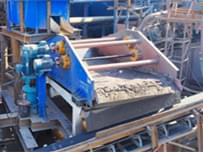
The price of high frequency dewatering screen is different depending on the model. The larger the processing volume, the more expensive the price. The high-frequency dewatering screen is linear dewatering equipment with a unique design with a large processing capacity and sufficient dewatering. It is widely used in filtering and dewatering operations such as dry tailings, concentrate dewatering, slurry concentration, and slurry separation. The dewatering screen can be used in conjunction with a cyclone. The dehydration efficiency is higher and more adequate. The structure of the high-frequency dewatering screen is mainly composed of a screen box, a vibration exciter, a supporting system, and a motor. The high-frequency dewatering screen uses a vibrating motor as a vibration source to make the screen body perform the periodic reciprocating movement in a linear direction to achieve grading and dewatering of materials. The high-frequency dewatering screen has the functions of dewatering, conveying, and low noise. It can effectively combine vibration conveying, dewatering, and vibration absorption into the screening machinery. The material is usually fed evenly into the inlet of the dewatering screen by a feeder, and several specifications of over sieve and underserved are produced through the multi-layer screen and discharged from their respective outlets. High…
read more >>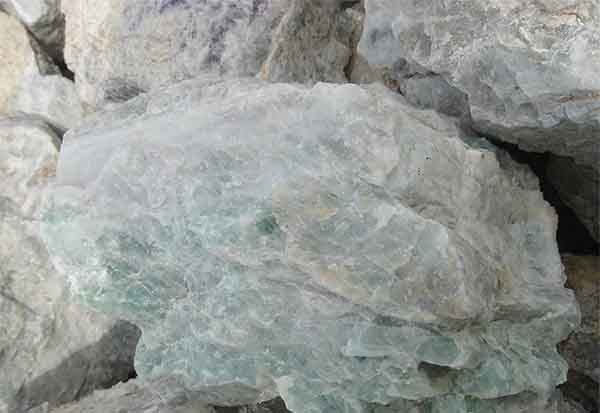
Flotation is the main method of fluorite beneficiation, and the development of high-efficiency flotation reagents and improvement of the flotation process are the keys to improving flotation indexes. The core issue of the fluorite flotation process is how to effectively sort and separate fluorite ore and associated ore (commonly quartz, calcite, barite, sulfide, etc.). The flotation reagents for fluorite ore mainly use collectors and inhibitors. 1. Quartz-type fluorite beneficiation Quartz-type fluorite ore is mainly composed of fluorite (with a content of up to about 85%) and quartz. There is only a small amount of calcite, barite, and sulfide. The key to its separation is mainly to reduce the silicon content of the concentrate. In order to separate quartz and fluorite, the appropriate grinding fineness must be determined, and the monomers of quartz and fluorite must be dissociated through grinding operations. Therefore, the grinding fineness is an important factor affecting the flotation of quartz-type fluorite. A stage grinding-stage flotation process is recommended to adopt, which can not only reduce the silicon content in the fluorite concentrate after flotation, but also increase the recovery rate of the fluorite concentrate. 2. Carbonate type fluorite beneficiation The main minerals of carbonate-type fluorite ore are fluorite and calcite,…
read more >>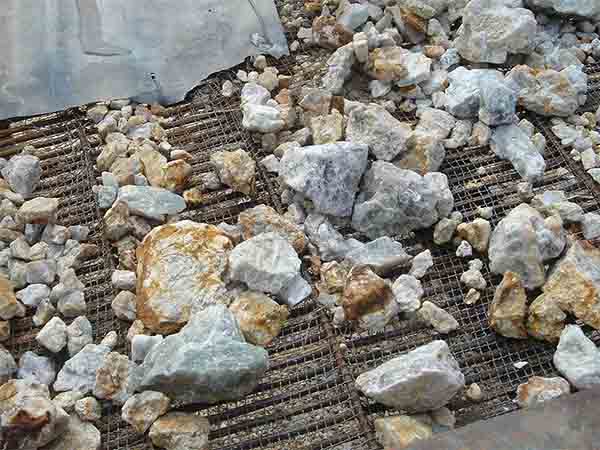
The common mineral processing methods of fluorite mainly include hand separation, gravity separation, and flotation. Due to the dilution of fluorite ore and the interlacement of fluorite and gangue, flotation has become the main beneficiation method for separating fluorite and gangue minerals. The gravity separation method is suitable for the production of metallurgical grade block ore or pre-concentration of the fluorite flotation process. Hand separation is often used as an auxiliary method for other fluorite beneficiation methods. 1. Hand separation method The manual separation method is mainly used for fluorite ore where the boundary between fluorite and gangue is very clear, waste rock is easy to remove, and different grades of ore are easy to be identified by naked eyes. After punching and screening, the raw ore can be divided into large blocks, medium blocks and particles (6-15mm), which can be manually sorted and stacked according to grade. Particle ore into gravity separation, debris by flotation processing into fluorite concentrate. 2. Gravity separation method The Fluorite gravity separation method is mainly used to separate the particle ore with high grade and particle size of 6-20mm. Fluorite gravity separation process: The raw ore is broken to below 25-30mm and then classified. The fine particles…
read more >> Fluorite ore beneficiation methods mainly include manual selection, gravity separation, and flotation. Manual selection is often used as an auxiliary method. Gravity selection is suitable for metallurgical-grade lump ore production or as a pre-selection operation for the fluorite flotation process. The flotation effect of fluorite can be improved by improving the grinding fineness, the temperature of the slurry, the flotation reagent, the slurry level, the pH value of the slurry, the water quality, and the flotation process. 1. Ensure proper grinding fineness In fluorite flotation beneficiation, the grinding fineness directly affects the final beneficiation index of fluorite concentrate. It is necessary to determine the appropriate grinding fineness according to the particle size of the useful minerals, so that the useful minerals and the gangue are basically dissociated. When the flotation particle size is relatively coarse, the flotation selectivity is high, the grade of fluorite concentrate is low, and the recovery rate is high. When the flotation particle size is medium, the fluorite concentrate grade and recovery rate are both high. When the flotation particle size is finer, the fluorite concentrate grade and the recovery rate are both lower. Therefore, in order to obtain the ideal fluorite grade and recovery rate, the beneficiation test…
read more >>


Copyright © 2015 - 2026 Luoyang Longzhong Heavy Machinery Co., Ltd. Website Map | Privacy policy | Contact Us




Inquiry