


What Is Sand Washing Machine?
Published: 07/11/2018
A sand washing machine removes clay, silt and dust from sand, then takes the water back out so the material can be stockpiled and sold. Every industrial unit does those two things, in that order. What changes between machines is how the fines are separated, and where the dirty water goes.
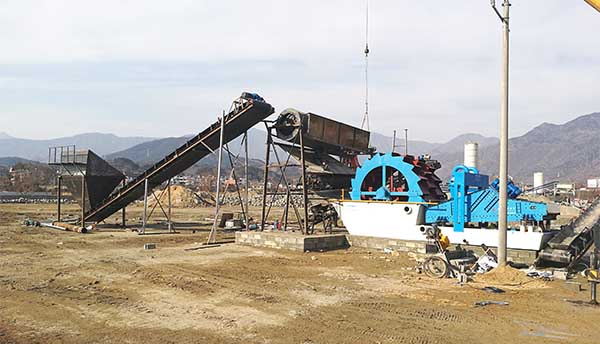
What the Sand Washing Machine Actually Does
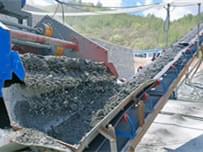
Feed enters a tank or a trough and is agitated in water. Clay sitting on the surface of the grains breaks off and stays suspended. The clean sand is lifted out — by buckets on a wheel, or by a spiral flight — and drains on the way up. The dirty water overflows and goes wherever the site sends it.
That is the washing step. Everything else on a plant exists to handle the two problems washing creates: fines that leave with the overflow, and water that has to go somewhere.
Three Families, One Difference
Sand washers come in three families. The difference that matters is what happens to the water leaving the tank.
Bucket wheel. A wheel with buckets lifts sand through a water tank and drains it on the way up. Cheap, simple, tolerant of coarse feed, and the most common unit in natural sand operations. The overflow carries fine sand with it — a few tonnes per hour on a feed with a lot of minus-75-micron material. Discharge moisture lands around 15-20%.
Screw (spiral). A spiral flight conveys sand up an inclined trough while water runs counter-current. Longer dwell time than a bucket wheel, so it handles sticky clay better. Same weakness at the overflow, same 15-20% moisture.
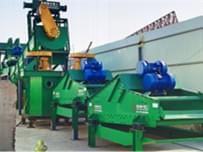
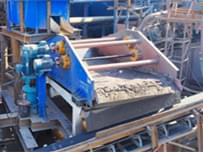
Wheel with cyclone and dewatering screen. The washer scrubs and lifts, a slurry pump sends the overflow to a hydrocyclone, and the underflow lands on a dewatering screen. Three jobs on one skid: wash, recover fines, dewater. LZZG builds this type from 20 to 400 t/h; it holds over 90% of the 0.074-3 mm fraction the other two lose, and discharges at 12-15%.
Which of the three fits a given feed — and what log washers, trommels and attrition scrubbers add — is compared feed by feed on the eight types page.
What Sand Washing Machine Removes
Two different materials, handled differently.
Lumps of clay sit on the surface of the grains. Washing wets them and moves them around. Above roughly 10% clay content, or when the clay binds the feed into lumps, an attrition scrubber goes in ahead of the washer to break the coating first. A bigger washer does not solve a clay problem.
Fine particles are mixed through the whole volume. The number that matters is the share passing a 75 micron sieve, because most concrete sand specifications cap it. A hydrocyclone cuts below 150 microns and holds the 0.074-3 mm fraction that a plain washer lets go with the overflow.
What Sand Washing Machine Cannot do
Four things come up in nearly every enquiry, and none of them is solved by picking a different machine:
- It cannot remove clay that has not been broken up. That is a scrubbing job, sometimes two stages of it.
- It cannot make coarse sand finer. Washing removes material; it does not reduce particle size.
- It cannot recover fines that already left the plant upstream. No amount of dewatering downstream brings them back.
- It cannot clean a feed that is mostly silt. That is a different process, and sometimes a different plant.
Where Sand washing Machine Is Used
- Sand and gravel pits, where the feed is dredged or excavated and the clay is loose.
- Manufactured sand lines, after a VSI or a cone crusher, where crusher dust has to come out to meet a spec.
- Concrete batching plants that buy raw sand and need it inside a fines limit before it goes into the mix.
- Glass sand and frac sand prep, where the fines limit is tighter than concrete and the moisture limit is tighter still.
- Coal and mineral washing, where the same principle separates waste from product.
- The common thread: somewhere downstream a buyer has a spec with a fines limit, and the site cannot meet it dry.
Where the Water Goes Decides the Cost
Two plants with the same washer can differ by a factor of two in capital cost, and water is the reason.
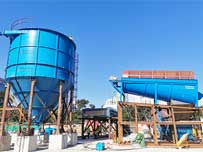
If water is cheap and a settling pond is permitted, the plant is a washer and a stockpile. If it is not, the plant needs a thickener to settle the clay and a filter press to turn the underflow into cake you can truck away. That circuit recycles about 95% of the water, so make-up drops to what leaves with the sand and the cake.
The deciding factor is usually the permit, not the economics.
Reading a Spec Sheet
Three numbers are worth checking before comparing prices:
Capacity in t/h of feed, not of product. A 100 t/h machine fed material with 15% fines does not deliver 100 t/h of sand.
Water demand in m³/h, quoted at the design feed rate. This sets the pump, the pipe and the make-up bill.
Discharge moisture. 12% and 20% are different machines, and they stockpile differently.
The buying decision behind those numbers is a longer conversation — feed rate, fines share, clay content, water cost, discharge moisture. We put it in how to choose a sand washing machine for your plant.
If you are sizing an sand washing unit, the sand washing machine range lists models by capacity, and the six-stage flow shows where each one sits in a line.





Send Message
Please write down your requirement and contact details in the following form. You can also send a message to us by this email export@lylzzg.com, we will reply to you within 24 hours.