


100 t/h Soil Washing Production Line For Sudan Customer
Project Introduction
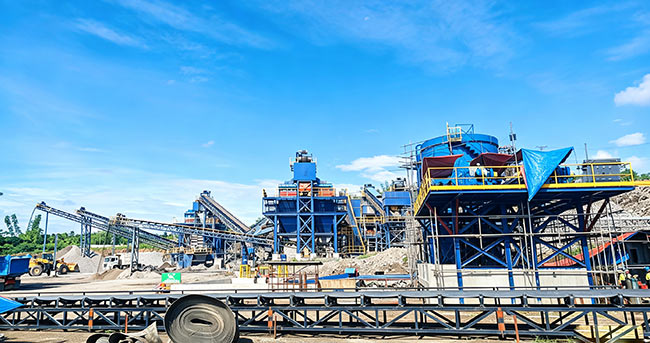
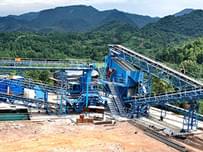
This washing production line belongs to the soil washing section in Sudan, specially designed to treat inorganic mineral wastes such as sand and gravel, muck, and mine slag.
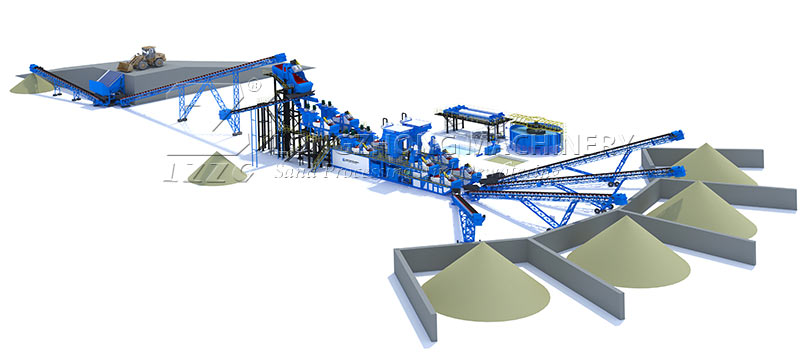
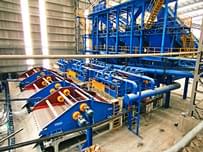
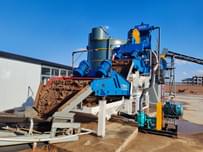
The complete washing process includes oversize screening, crushing, scrubbing and desliming, wet classification, fine sand recovery and dewatering, organic matter and fine sludge separation, fully closed-loop water treatment, and sludge filter press dewatering.
Project Requirement
| Item | Specification |
| Capacity | 100 tons per hour, continuous operation for 8 hours per single shift |
| Feed Materials | Inorganic inert wastes such as muck, waste concrete, bricks and tiles, mine slag, and inorganic silt |
| Feed Control | Maximum particle size of incoming materials: 300 mm; after pre-screening, feed size is limited to 0–80 mm, with 63–80 mm oversize materials accounting for 10%–20% of the incoming feed |
| Output Standard | Output materials comply with EU End-of-Waste (EoW) criteria and UNI EN aggregate series standards; finished products can be directly sold as commercial aggregates |
Soil Washing Process Flow
Material Feeding → 63 mm Classification Screening → 63–80 mm Oversize Crushing Circuit → Belt Magnetic Iron Removal → Scrubbing and Desliming → Wet Classification → 0–4 mm Fine Sand Recovery and Dewatering → Light Organic Matter & Ultra-fine Sludge Separation → Closed-loop Water Treatment System → Wet Classification → High-pressure Filter Press Dewatering
Detailed Description of Soil Washing Process
1. Feeding and Pre-Screening
Equipped with a wear-resistant large hopper and a variable frequency adjustable feeder, with continuous belt weighing and metering. The pre-screening divides materials into qualified feed of 0–63 mm and oversize material of 63–80 mm.
2. Crushing and Circuit
All 63–80 mm stone materials are fed to the crusher to be crushed below 63 mm, and fully returned to the front end of the washing process for re-washing and re-classification. No crushed stone products above 63 mm are produced separately, ensuring homogeneous and up-to-standard aggregates.
3. Magnetic Iron Removal
Belt type permanent magnet iron remover can remove metal impurities such as steel bars and iron nails in advance, protecting the rear end scrubbing and screening equipment.
4. Scrubbing and Washing
A twin-shaft paddle scrubber is used to strongly strip clay agglomerates on aggregate surfaces, equipped with 4–20 mA online water flow monitoring; wear-resistant liners and paddles are replaceable.
5. 4–63 mm Wet Classification
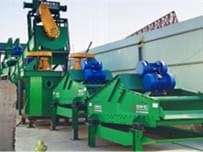
The wet screening is set with classification cut points of 4/10/18/28/63 mm, separating 4 grades of commercial crushed stone in one pass. Each grade is independently washed and dewatered to control residual moisture and fines content of finished products.
6. 0–4 mm Fine Sand Recovery & Dewatering
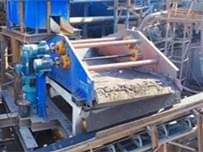
Hydrocyclones separate silt (< 0.063 mm) from fine sand. The fine sand is then fed to a high-frequency dewatering screen for dewatering, producing clean finished sand.
7. Ultra-fine Sludge Separation
A turbid slurry mixing tank and wedge wire screens are used to separate floating plastics and wood chips. All silt below 0.063 mm is sent to the sludge treatment system and not counted as finished products. Organic debris is collected and stockpiled separately.
8. Closed-loop Water Treatment + Sludge Filter Press
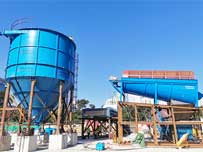
High-efficiency thickener is adopted for dynamic flocculation and sedimentation, with all overflow clear water recycled and reused. The high-pressure chamber filter press delivers a stable dry solid content of 65%–75% for the filter cake.
In addition, a large-capacity sludge homogenization buffer tank is configured to balance continuous washing and intermittent filter press operations, supported by an automatic flocculant preparation and dosing system.
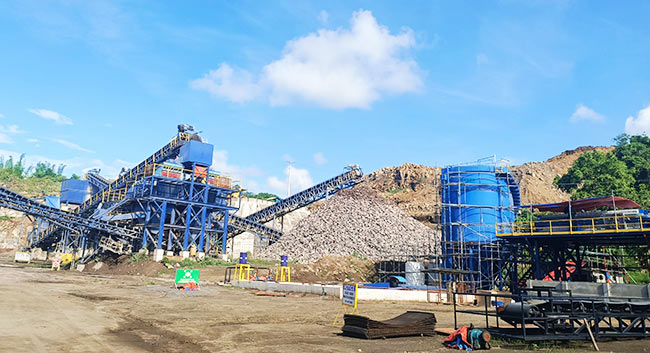
100 t/h Soil Washing Plant Actual Output
| Materials | Capacity |
| 63–80 mm Crushed and Returned Materials | 10%–20% of the incoming feed (internal circulation, not for external sale) |
| 4–63 mm Gravel | 40–55 t/h |
| 0–4 mm Sand | 30–45 t/h |
| Sludge Fines (< 0.063 mm) | 5–20 t/h |
| Separated Organic Waste | < 5 t/h |
The maximum particle size of the incoming raw materials is 300mm, and after pre screening, the feeding is limited to 0-80mm. The production line can process high clay slag with a surface soil proportion of up to 80% in a short period of time, and the system reserves overload buffer without stopping the machine.
Partial Equipment List for Soil Washing Production Line
| Group / Machine | Key Data | Function |
| Steel hopper 6 m³ + belt feeder + control grid | — | Reception and feeding |
| Belt conveyor | — | Conveying |
| Belt magnetic separator | 1.5 kW | Iron removal |
| Drum scrubber with screening, Ø1600×6000 | 100 t/h | Scrubbing/washing |
| Turbid-flow repulping tank + organics separation | 30 kW | Repulping and organics separation |
| Hydrocyclone Ø420 | 15 kW | Fines/sand separation |
| Hydrocyclone Ø600 | 30 kW | Sand recovery |
| Diaphragm metering pumps (chemicals) | 0.37 kW ×3 | Reagent dosing |
| Twin-shaft paddle scrubber, 4580 mm rotors | 18.5+18.5 kW | Washing of clayey material |
| Gravel dewatering screen, 1500×3000 | 30 kW | 4–63 mm dewatering |
| Organics extraction/dewatering screws | 4 kW | Conveying/dewatering |
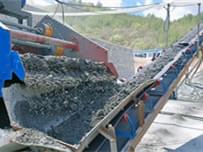
| Gravel evacuation conveyors | 2.2 kW | Product evacuation |
| Dynamic circular settler Ø12 m, 500 m³ | — | Primary clarification |
| Sludge storage/homogenisation tank 50 m³ | 5.5 kW | Sludge homogenisation |
| Clarified-water storage tank 50 m³ + pumps | 30+30 kW | Water recycling |
| High-pressure chamber filter press | 45 kW | Sludge dewatering |
| Automatic flocculant dosing equipment | 0.55 kW | Flocculant preparation and dosing |
| Static secondary settler Ø3 m | 7.5 kW | Secondary clarification |





Send Message
Please write down your requirement and contact details in the following form. You can also send a message to us by this email export@lylzzg.com, we will reply to you within 24 hours.