
Overview
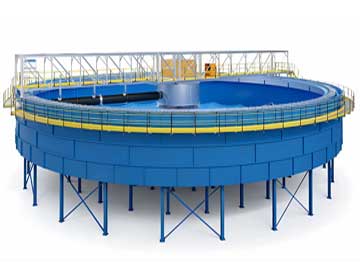
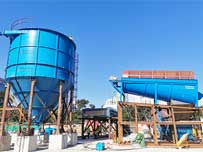
LZZG high-rate thickener is a circular tank where flocculant-dosed feed enters through a deep centre well and settles fast enough for a 20 to 30 m tank to carry thousands of cubic metres of water an hour. A rake turns slowly underneath and walks the bed to the centre cone.
It belongs to the gravity thickener family. Gravity does the settling; the high-rate version adds a flocculant feed point and a deeper feed well, and that is what buys the throughput on the same footprint. On flowsheets and inquiry sheets the unit is often written as a gravity thickener.
Slurry enters at 10% to 20% solids. Underflow leaves at 45% to 55% in a single pass. Overflow is clean enough to go back to the plant.
-
Working principle
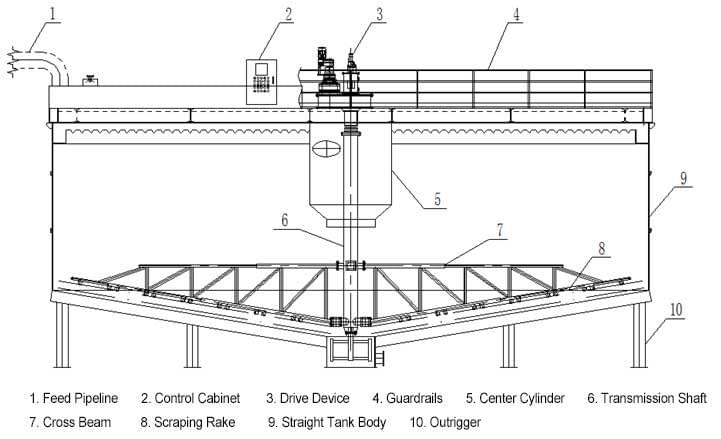
Slurry is dosed with flocculant and enters through the centre feed cylinder. A guide plate spreads it sideways out of the cylinder. Feed that plunges straight down breaks its own flocs and short-circuits to the overflow, and that is the usual reason a new tank starts up with turbid water.
Solids settle into a bed. The rake turns slowly and walks the bed toward the centre cone. Underflow leaves the bottom at 45% to 55% solids. Clarified water rises and goes over the top weir.
-
Features & Benefits
- 10 to 30 m tanks, 250 to 5,000 m³/h. One class covers a small quarry and a 5,000 m³/h wash plant.
- 78 to 708 m² of settling area, 3.2 to 7.1 m³/h per m². Tank size follows your water flow, and 708 m² carrying 5,000 m³/h still fits inside an existing plant.
- 10% to 20% feed becomes 45% to 55% underflow in one pass. Thick enough for a filter press or a dewatering screen.
- Hydraulic multi-point drive, stepless speed, 11 to 22 kW, torque-monitored rake lift. Rake speed follows the bed, and a heavy bed lifts the rake instead of stopping the plant.
- Lowest flocculant use of the four main thickener types. Flocs only have to fall a short distance.
-
Specifications
Model Diameter (m) Settlement Area (m²) Taper (°) Power (kw) Overall Size (m) NMJ10 10 78 10 11 φ10*7.9 NMJ12 12 113 10 11 φ12*8.1 NMJ14 14 153 10 11 φ14*8.3 NMJ16 16 200 10 11 φ16*8.5 NMJ18 18 254 10 11 φ18*8.7 NMJ20 20 314 10 11 φ20*8.9 NMJ22 22 380 10 16.5 φ22*9.1 NMJ24 24 450 10 16.5 φ24*9.2 NMJ26 26 530 10 16.5 φ26*9.6 NMJ28 28 615 10 22 φ28*9.8 NMJ30 30 708 10 22 φ30*10 Where a High-Rate Thickener Stops Being the Answer
This machine handles the water side of a plant: a big flow, a clean overflow and a flocculant bill you want to keep small. Three situations push the job onto a different tank.- You need more than 55% solids in the underflow. Feeding a high-rate tank harder gives you more turbid water, not thicker mud. Density comes from time under load, which means height. That is the rakeless deep cone thickener, at 60% to 70%.
- The plan area is the constraint. This tank settles on surface area, so it needs 78 to 708 m² of ground. A deep cone settles on volume and stands on 10 to 113 m². The difference gets paid back in height.
- Nobody on site maintains a drive. This unit has a hydraulic drive, a gearbox and a rake lift. The deep cone has none of the three.
Item High-rate thickener Rakeless deep cone thickener Rated on 250–5,000 m³/h of water, divided by settling area under 50–1,200 t/h of water, divided by tank volume Underflow 45%–55% solids 60%–70% solids Wins on large flows, low flocculant, clean overflow stiff underflow, small footprint, nothing to maintain 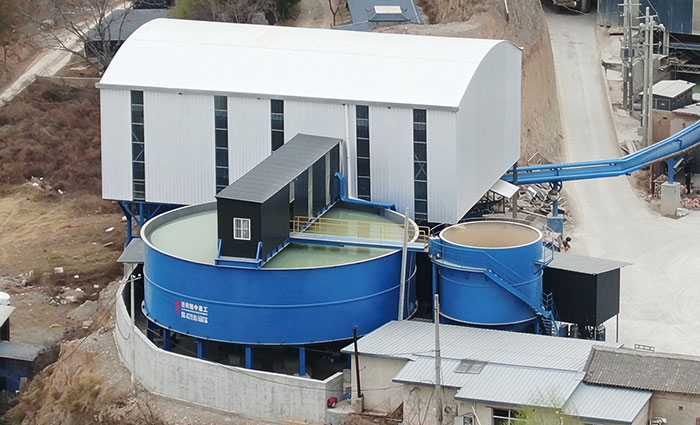
Questions Buyers Ask Before Ordering
Is a gravity thickener the same as a high-rate thickener?
No. A paste thickener is defined by what hangs in the bed: low rake arms with dewatering pickets, a deeper mud bed and a slow rake, holding the underflow above 100 Pa. A deep cone has no rake, no drive and no pickets, and works at 30 to 60 Pa, where the underflow still pumps with a centrifugal.How big a tank do I need?
From the flow, at 3.2 to 7.1 m³/h per m² of settling area. A 2,000 m³/h stream lands between NMJ20 (20 m, 314 m²) and NMJ26 (26 m, 530 m²).What underflow density can I get?
45% to 55% solids from a 10% to 20% feed, in one pass. If the target is 60% to 70%, that is a deep cone, not a bigger high-rate tank.Can it replace a clarifier?
It does the same job: solids down, clear water over the weir. What it does not do is polish water for discharge to a river. That needs a filter behind it.Why is the overflow still turbid?
Usually the flocculant dose, the bed height or the feed well. Causes and fixes are in this troubleshooting note. -
Inquiry
Please write down your requirement and contact details in the following form. You can also send a message to us by this email export@lylzzg.com, we will reply to you within 24 hours.







Inquiry