| Specifications |
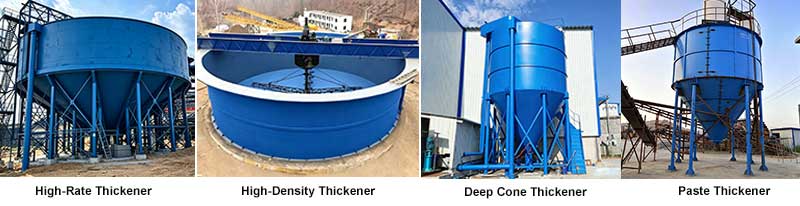
High-Rate Thickeners |
High-Density Thickeners |
Deep Cone Thickeners |
Paste Thickeners |
| Core Structure |
Rotating rake; low side wall, mild bottom slope |
Rake + vertical drain rods; taller side wall, steep bottom slope |
No rakes / moving parts; tall tank, 60° steep bottom |
Rake + dense drain rods; ultra-tall side wall, 30°/45° steep bottom |
| Underflow Yield Stress |
10–30 Pa (medium density) |
50–100 Pa (high density) |
30–60 Pa (medium-high density) |
>150 Pa (paste, max density) |
| Discharge Pump |
Centrifugal pump |
Centrifugal pump |
Centrifugal pump |
Positive displacement pump |
| Sludge Bed Retention Time |
1–2 h |
2–4 h |
4–8 h |
4–10 h |
| Flocculant Consumption |
Very low |
Medium |
Relatively high |
Medium |
| Water Recovery Rate |
~85% |
Higher than HRT |
Medium |
Industry maximum |
| Overflow Clarity |
Excellent |
Excellent |
Good |
Moderately acceptable |
| Floor Space |
Compact |
Smallest |
Minimal |
Medium (tall tank) |
| Drive System |
Hydraulic, with rake lift & torque monitor |
Hydraulic, with rake lift & torque monitor |
No drive unit |
High-torque hydraulic drive |
| Maintenance Workload |
Low |
Low |
Minimal |
Medium |
| Equipment Cost |
Low, cost-efficient |
Medium |
Medium |
High |
| Total Operation Cost |
Lowest |
Medium |
High (high chemical cost) |
Medium (high pump & civil cost) |
| Core Strengths |
Large capacity, low chemical use, clean overflow |
High thickening effect, fits filtration & counter-current washing |
Simple structure, ultra-reliable, few failures |
Paste underflow without free water, small tailings yard |
| Main Drawbacks |
Cannot produce paste underflow |
Higher configuration cost |
Heavy flocculant reliance |
High investment, limited throughput |
| Suitable Scenarios |
Sand/coal mines, water-short plants, general tailings thickening |
Pre-treatment before filters, counter-current washing |
Remote mines, sites with few maintenance workers |
Strict environmental projects, tailings dry stacking, overseas large mines |
| Unsuitable Scenarios |
Projects requiring paste dry stacking |
Extremely narrow sites without professional staff |
Sites with tight chemical control & high density demand |
Low-budget sites, places unable to install displacement pumps |








Send Message
Please write down your requirement and contact details in the following form. You can also send a message to us by this email export@lylzzg.com, we will reply to you within 24 hours.