


Conventional Thickener VS High Rate Thickener
Published: 06/16/2026
The main function of a thickener is to separate solid particles from liquid phase. Thickeners play a vital role in mineral processing operations. By facilitating gravitational sedimentation to settle fine particles, they efficiently separate and concentrate valuable minerals from slurry.
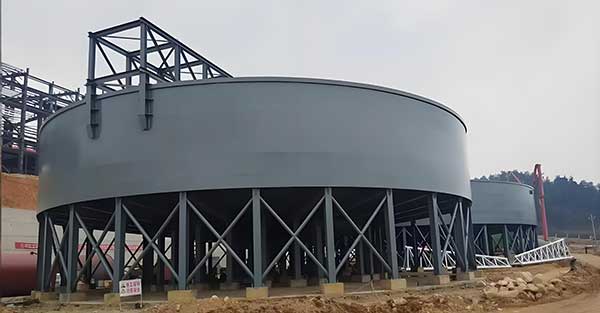
In practical applications, thickeners can be divided into conventional thickeners and high-rate thickeners according to different requirements.
What Is Conventional Thickener?
A conventional thickener, also known as a conventional gravity thickener, relies entirely on natural gravity to achieve solid-liquid separation. The thickening process involves continuously feeding slurry into the thickener. As the slurry settles, solids accumulate at the bottom, while the clarified water rises to the top and is collected for reuse. The settled solids, known as the underflow or thickened slurry, are then discharged for further processing. Standard models generally do not include a chemical dosing system.
What Is High Rate Thickener?
High rate thickeners are designed to handle higher throughput. The equipment is equipped with a dedicated flow guide, paired with a complete flocculant dosing and mixing system; some models also feature a degassing structure. Under controlled flow conditions, fine particles aggregate into large, dense flocs, significantly increasing the settling rate. The compact design and short residence time enable highly efficient thickening.
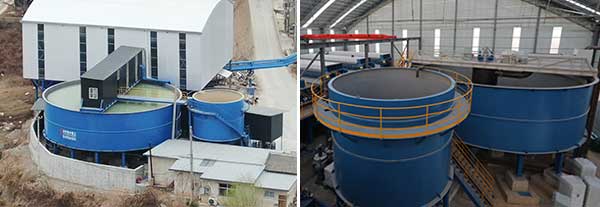
Full Comparison Table (Conventional VS High Rate Thickener)
| Comparison | Conventional Thickener | High Rate Thickener |
| Working Principle | Free gravity settling of individual particles | Flocculation-enhanced settling of floc aggregates |
| Settling Speed | Slow; Basic settling rate | 2~10 times faster than conventional type |
| Footprint | Large diameter tank and occupies a huge area | Reduce floor space by up to 80% |
| Residence Time | Long (12~24 h) | Short (1~4 h) |
| Flocculant | Little or no flocculant required | Flocculant dosing is necessary; Stable dosage control required |
| Underflow Density | Low to medium; Limited thickening effect | High to extra-high; Stable high-concentration sludge output |
| Overflow | Moderate clarity; Turbid when handling fine sludge | High clarity; Low SS value, good water recycling performance |
| Throughput Capacity | Low; Limited production capacity | High; Greatly improved throughput under same tank volume |
| Installation Cost | High (Large foundation & civil works) | Low (Compact design, simple foundation) |
| Adaptability | Fine particles are hard to settle | Specially optimized for fine & ultra-fine slurry |
| Daily Maintenance | Few wearing parts, low maintenance difficulty & cost | More auxiliary systems; Regular inspection for dosing & mixing units |
| Power Consumption | Low (Only low-speed rake operation) | Medium (Add power for dosing pump & mixing device) |
How to Choose a Thickener?
If your facility has ample space, a relatively low daily processing capacity, and primarily handles coarse-grained sludge, and if your priority is to control operating and maintenance costs, a conventional thickener is a suitable choice.
For high-capacity production lines, sites with limited space, or applications involving fine-grained tailings or coal slurry, or if you have strict requirements for sludge concentration or water recovery rates, a high-efficiency thickener is the preferred option.





Send Message
Please write down your requirement and contact details in the following form. You can also send a message to us by this email export@lylzzg.com, we will reply to you within 24 hours.