


Soil Wash Plant: How Soil Washing Works and How to Size It
A soil wash plant separates excavation soil, dredging spoil and demolition waste into saleable aggregate, sand and a small sludge residue. It does this with water and mechanical action only — no chemicals in the aggregate stream — which is why the output can be sold as aggregate instead of buried as waste. This page covers what the plant does, which module sizes what, and the five numbers that decide the layout.
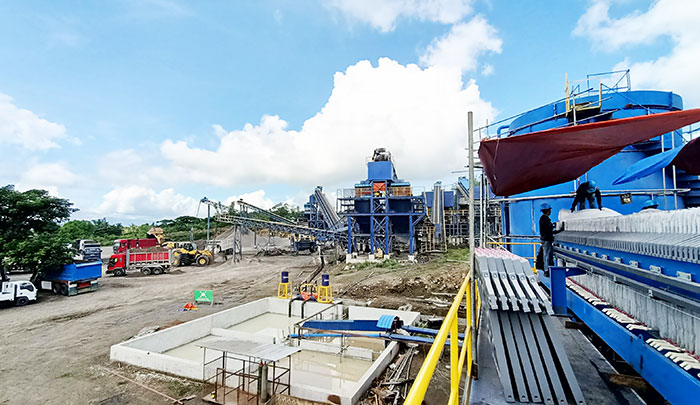
What a Soil Wash Plant Is
Feed soil is not one material. It is aggregate grains glued together by clay, mixed with silt, organic debris, roots, plastic and occasional steel. Washing does two things at once: it breaks the clay bonds mechanically, then classifies the result by particle size and settling rate. Everything above roughly 0.063 mm becomes a product; everything below it becomes sludge.
- Aggregate — 4–63 mm gravel, split into several grades for concrete, drainage or sub-base
- Sand — 0–4 mm, recovered on a dewatering screen rather than lost over the thickener
- Sludge — silt and clay below 0.063 mm, pressed to a stackable cake
- Rejects — steel on the magnet, plastics and wood on the water surface
The dividing line at 0.063 mm is not arbitrary. It is the point where a hydrocyclone can still separate particles by centrifugal force, and it is also the sieve most aggregate standards use to define fines content. Get that cut right and the plant produces; get it wrong and the sand goes to the sludge tank and you pay twice — once for the lost product, once for the disposal.
The Four Names Buyers Use
Soil wash plant, soil washing plant, soil washing equipment and soil recycling plant describe the same installation. Suppliers use them interchangeably, and search traffic splits across all four. What changes between them is not the machine but the duty: recovery of inert waste, or treatment of contaminated ground.
When a Soil Wash Plant Pays For Itself
The economics are simple to state and hard to fake. You are trading a disposal cost for a product revenue, and the ratio between them decides the payback.
| Line | What It Means In Practice |
|---|---|
| Gate fee avoided | Every tonne recovered does not go to landfill or to a licensed handler. In markets where inert disposal is expensive, this alone carries the plant |
| Product revenue | Washed 4–63 mm gravel and 0–4 mm sand sell into the same market as quarried aggregate, often at a discount that still beats the gate fee |
| Residue cost | Only the sludge leaves, and it leaves as cake at 65–75% dry solids, so you are paying to move water only once |
| Recovery ratio | The number to model. On the reference build below, 100 t/h of feed yields 70–100 t/h of saleable aggregate and 5–25 t/h of residue |
If your feed is more than about a third clay, the arithmetic changes: recovery drops, the sludge stream grows, and the filter press becomes the bottleneck rather than the washer. That is a design question, not a reason to walk away — but it has to be answered before the layout is drawn.
Two Duties, Two Designs
| Inert Excavation and C&D Waste | Contaminated Site Soil | |
|---|---|---|
| Typical feed | Muck, spoil, waste concrete, brick, tile, slag | Soil carrying heavy metals, hydrocarbons, salts, asbestos fragments |
| Objective | Recover aggregate, cut landfill volume, reach End-of-Waste | Concentrate contamination into a small fraction |
| Product | Graded gravel and sand sold as aggregate | Clean coarse fraction for reuse or fill; contaminated fines cake |
| Design pressure | Clay content, lump size, product standards | Contaminant distribution by size fraction, dust and containment, water treatment |
| Instrumentation | Feed weighing, water flow, level control | Above that: pH, turbidity, possibly metals monitoring, sealed enclosures |
| Residue route | Inert landfill, or reuse as fill | Hazardous or regulated disposal, tracked by consignment |
Most plants sold as soil wash plants are the first type. The second type is a washing line with a stricter water circuit and much more sampling around it. If your material is contaminated, say so early: the washing stage is largely the same, but the sludge side and the paperwork are not.
The Five Modules Every Soil Wash Plant Has
| Module | What It Does | What Happens If It Is Undersized |
|---|---|---|
| Feed and sizing | Hopper, variable-speed feeder, belt scale, pre-screen, optional crusher on the oversize | Lumps choke the scrubber; feed rate wanders and every cut point downstream drifts with it |
| Scrubbing | Drum scrubber or twin-shaft paddle scrubber breaks clay agglomerates off the grain | Clay survives into the product as lumps; silt content fails the standard and the buyer rejects the load |
| Classification | Multi-deck wet screen at the market cut points — typically 4/10/18/28/63 mm | Grades blend into each other; you sell one mixed pile instead of four priced products |
| Fines and sand recovery | Hydrocyclones plus a high-frequency dewatering screen | Sand overflows to the thickener and leaves as cake — the single most common way these plants lose money |
| Water and sludge | Thickener with flocculant dosing, buffer tank, chamber filter press | Water goes cloudy, the loop opens, make-up demand spikes and the cake will not stack |
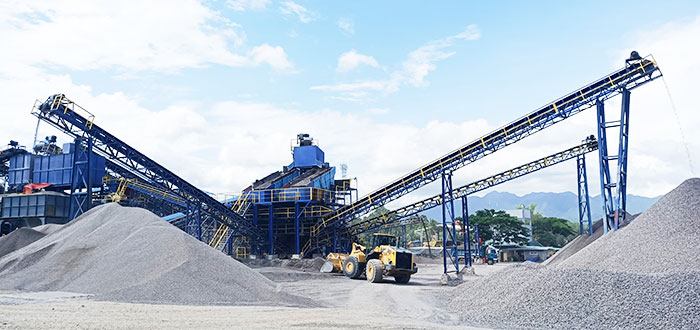
Process Flow, Stage By Stage
1. Reception and Pre-Screening
A wear-resistant hopper with a control grid takes the raw load; a variable-frequency feeder with continuous belt weighing meters it into the pre-screen. The pre-screen makes the first split: undersize goes to the wash, oversize goes to the crusher.
2. Oversize Crushing
Oversize is crushed below the screen aperture and returned to the front of the plant, not sold as a separate product. Returning it keeps the output homogeneous, which matters when the product has to be declared against a standard.
3. Iron Removal
A belt-type permanent magnet over the conveyor takes out rebar, nails and wire before the scrubber. It is cheap insurance for the equipment downstream.
4. Scrubbing and Desliming
This is the stage that actually washes. A drum scrubber handles mixed feed with moderate clay; a twin-shaft paddle scrubber handles the sticky, high-clay material that a drum would simply carry through. Water is added here, and the clay leaves as a suspension rather than as a coating on the grain.
5. Wet Classification
Multi-deck wet screening splits the flow into commercial grades at fixed cut points. Each deck washes and dewaters its own product, so residual moisture and fines content can be held per grade instead of averaged across a mixed pile.
6. Sand Recovery and Dewatering
Hydrocyclones cut the 0–4 mm stream at about 0.063 mm: sand to the underflow, silt to the overflow. The sand goes onto a high-frequency dewatering screen and leaves at handling moisture. This stage decides the recovery ratio.
7. Organics and Debris Separation
A repulping tank with wedge-wire extraction takes out floating plastic, wood and roots. On demolition feed this stage matters more than it looks — organic content is what makes a load fail an aggregate specification regardless of how clean the gravel is.
8. Water Treatment and Sludge Dewatering
A thickener doses flocculant and settles the fines; overflow returns to the wash as clear water. Underflow goes to a buffer tank and then to a chamber filter press, which delivers cake at 65–75% dry solids. The buffer tank is what lets a continuous washer feed an intermittent press without stopping.
What Sets Capacity
Capacity on a soil wash plant is not a catalogue number. Two plants with the same nominal tonnage will run at different real throughputs depending on what is in the feed. Four things set it:
| Driver | Effect |
|---|---|
| Clay and silt percentage | More clay means more water, longer scrubbing residence time and a larger thickener. Above roughly 20–30% clay, a second scrubbing stage is usually the cheaper answer than a bigger single unit |
| Top size and oversize share | A 300 mm top size with 10–20% oversize puts a crusher in the circuit and adds a return load to the pre-screen |
| Number of cut points | Four saleable grades need more decks, more conveyors and more stockpile space than two |
| Product standard | A tight fines limit demands more washing water per tonne and a finer cut on the cyclone |
State capacity as the feed tonnage the plant holds at those cut points — not as the tonnage the washer could pass with clean sand.
Product Quality and Standards
| Parameter | Typical Target | How It Is Tested |
|---|---|---|
| Fines passing 75 µm | 3% for natural sand, up to 5% for manufactured sand in concrete work (ASTM C33); tighter for some EN classes | Wet sieving |
| Clay content in sand | Low; methylene blue value is the practical indicator | EN 933-9 methylene blue, or sand equivalent |
| Clay lumps and friable particles | Under 2–3% for structural concrete aggregate | ASTM C142 |
| Organic impurities | No staining beyond the reference colour | ASTM C40 |
| Grading | Within the envelope of the declared class | Sieve analysis against BS EN 12620, UNI EN or ASTM C33 |
Meeting a standard is not the same as being declared End-of-Waste. EU member states set their own criteria, and the usual conditions are: the material meets an existing product standard, there is a quality management system behind it, there is a market for it, and the competent authority accepts the case. The plant can be specified to make the product; the declaration is a separate process.
Water and Residue
The circuit is closed in the operational sense. Thickener overflow returns to the wash; make-up water covers evaporation, the moisture leaving in the filter cake and the moisture leaving with the product. There is no process water discharge, so the site needs a make-up supply rather than a continuous abstraction licence.
The residue is the cake. At 65–75% dry solids it stacks and can be handled by a shovel or a truck, which is the difference between a residue you can manage and a slurry you cannot. Where the cake still carries contamination, its route is decided by analysis, not by the plant.
Site Requirements
| Item | What To Plan For |
|---|---|
| Footprint | Conveyor layout usually decides it. Allow separate stockpile bays per grade plus a bay for cake |
| Power | Motors dominate the load — scrubber, screen, press and water pumps. Confirm the supply before the layout, not after |
| Water | A make-up source sized to evaporation plus cake and product moisture; a lined or concrete pit for the loop |
| Sludge off-take | A route for the cake — licensed landfill, a handler, or authorised reuse as fill |
| Buffer capacity | Raw feed stockpile and product bays, so the plant runs at rate rather than at the rate the excavator happens to deliver |
| Permits | Water abstraction or supply, discharge if any, waste registration, and — for contaminated soil — the treatment permit that governs the whole operation |
Reference Builds
The clearest way to read a soil wash plant is to look at one that is running.
- 100 t/h soil wash plant in Sudan — inert waste with a 300 mm top size, four gravel grades plus sand, End-of-Waste output, closed-loop water and filter-pressed cake. The full mass balance and equipment list are on that page.
- Sand washing plant overview — the same module set applied to sand and fine gravel feed, without the pre-screen and crusher.
- Sand washing machines — the individual washers, from screw and wheel units to twin-shaft scrubbers.
FAQ
How Much Does a Soil Wash Plant Cost?
Prices are not published because the plant is sized to the feed, and the feed is different on every site. The four cost drivers are the number of scrubbing stages, the number of product grades, the thickener and press duty, and the degree of automation. A quotation without feed gradation and clay percentage is a guess.
What Capacity Should I Plan For?
Size on the tonnage you actually handle in a shift, not the peak you hope for. The reference build runs at 100 t/h over an 8-hour shift with a 300 mm top size and produces 70–100 t/h of saleable aggregate. Send the feed gradation and clay percentage and the same module set can be sized for your tonnage.
Previous:How To Remove Fine Sand From Aggregate
Next:none





Send Message
Please write down your requirement and contact details in the following form. You can also send a message to us by this email export@lylzzg.com, we will reply to you within 24 hours.