


Sludge Storage Tank vs Thickening Tank: Which Do You Need?
Published: 11/26/2026
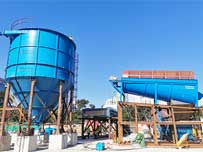
A sludge storage tank and a thickening tank share one shape. Both are circular, and both take sludge at the top. The difference is what leaves. A storage tank holds sludge at the solids percentage it arrived with. A thickening tank removes water and returns it to the plant.
Plants often buy one and need the other. The check takes two figures: dry solids per day, and the solids percentage the next stage can take. Tank sizing for the thickening side is set out in thickening tank design.
What Each Tank Does
Sludge storage tank. It buffers. Sludge arrives from a clarifier or a press at an uneven rate. The tank feeds the next stage at a steady flow. Some units mix, and some let the sludge settle and decant.
Thickening tank. It separates. Solids settle to the bottom cone and leave as underflow. Water rises and leaves over the weir as supernatant, which returns to the head of the plant. That stream is the thickener overflow.
Four Differences that Matter
| Item | Sludge storage tank | Thickening tank |
|---|---|---|
| Design basis | Volume | Settling area |
| Retention | Set by the press cycle or the haulage schedule | 12 to 48 hours in sludge duty, 1 to 3 hours in wash-water duty |
| Mixing | Often needed to stop stratification | None in the settling zone |
| Outlets | One, to the next stage or a tanker | Two, underflow and supernatant |
| Solids percentage | Unchanged in, unchanged out | Rises: 40% to 60% in wash-water duty, 4% to 6% in sludge duty |
When a Sludge Storage Tank Is Enough
- Sludge goes straight to a tanker, and haulage is charged per load on a fixed route.
- The next stage wants a steady flow more than a drier feed.
- Solids stay near 1% to 3% and the sludge leaves by tanker on a fee per load.
When You Need Thickening
- The press runs on a fixed chamber volume. Halving the water doubles the solids in each cycle.
- The digester, the filter press or the dryer is undersized for the solids load you have.
- The plant has a place to return supernatant, normally the head of the works.
The Volume Check
Take 100 m3/d at 1% solids. That is 1 t of dry solids and 99 t of water. At 500 g/L after thickening, the same tonne carries 1 t of water. The stream falls from 100 m3/d to 2 m3/d.
Chamber presses in sand washing take 400 to 600 g/L of feed. At 10 g/L, the same chamber holds a fiftieth of the solids, so one cycle replaces fifty.
Where sludge leaves by tanker, the count falls the same way. At 20 m3 per load, five loads per day become one load every ten days.
Sizing a Sludge Storage Tank In One Line
Volume equals daily sludge times days of storage. At 100 m3/d and two days, the tank is 200 m3. At 5 m side depth that is 40 m2 of plan area, or 7 m in diameter, plus freeboard.
Days of storage come from the press schedule or the haulage schedule, not from the settling test. A press on one shift needs a day of buffer. A weekend gap before collection needs three.
What Each Tank Costs To Run
Storage costs come from mixing and from moving the sludge. A mixer runs all day, and every cubic metre it keeps in suspension is a cubic metre the press must dewater.
Thickening costs come from the drive and the flocculant. A raked tank runs an 11 to 22 kW bridge. A rakeless deep cone runs no drive at all.
A thickener sized for 500 g/L and fed at 10 g/L runs a drive all day for water that never leaves.
Sludge Type Moves the Answer
Primary sludge settles fast and reaches 5% to 6% in a plain gravity tank. Waste activated sludge settles slowly, holds water inside the floc, and often needs polymer or a rakeless deep cone thickener.
Industrial sludge from metal finishing or sand washing runs denser. A cone-bottom tank with a decant line often covers that duty.
So the tank follows the sludge, before the volume check.
Can One Tank Do Both?
Yes, at a cost. A combined tank needs a settling zone, a decant line and a mixer. It runs at the slower of the two duties. Most plants split the two when the flow is steady enough to size each one.
The order is fixed in most layouts: thicken first, store second. Thickening cuts the volume, and storage then buffers a much smaller stream.
Questions Buyers Ask
How long can sludge sit in a sludge storage tank? Two to three days without mixing, and less in warm weather. Longer than that, and the sludge turns septic and the odour travels.
Does a sludge storage tank need a mixer? If it feeds a press or a digester at a steady solids level, yes. If it only holds sludge for a tanker, a cone and a drain are enough.
Which tank goes first in a plant? Thickening, then storage. The thickener needs enough residence to build a bed. The storage tank downstream then sizes on a fifth of the flow.
Storage buffers. Thickening separates. The volume check decides which one the plant needs, and the five inputs decide how large the thickening tank runs.
Previous:How Much Does a Sand Washing Plant Cost
Next:none





Send Message
Please write down your requirement and contact details in the following form. You can also send a message to us by this email export@lylzzg.com, we will reply to you within 24 hours.