


200 t/h Mountain Sand Washing Plant in Philippines
A quarry in northern Philippines needed to turn weathered mountain sand into concrete-grade aggregate. Local river sand is getting harder to permit, and the deposit they owned carried 15–18% silt plus a lot of loose rock. This case walks through what we shipped, how the line is laid out, and where the design choices actually matter.
Project At A Glance
| Item | Value |
| Location | Philippines (quarry, northern region) |
| Feed material | Weathered mountain sand, ≤ 300 mm |
| Capacity | 200 t/h of finished sand and gravel |
| Operating hours | 16 h/day, ~300 days/year |
| Main products | 0–5 mm, 5–10 mm, 10–20 mm, 20–31.5 mm |
| Installed power | ~480 kW |
| Footprint | ~90 m × 30 m |
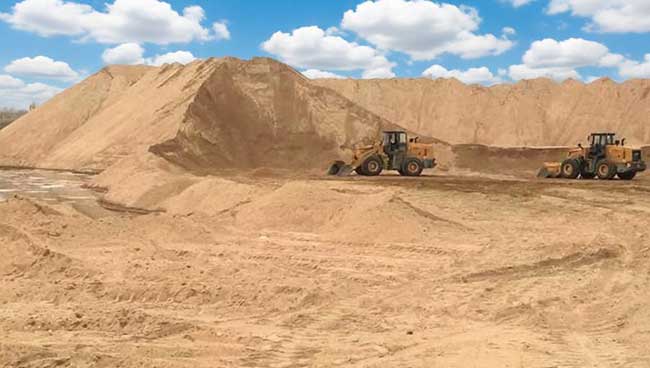
Why mountain sand is different?
River sand needs little more than a rinse. Mountain sand does not.
The feed from this site comes out of the hillside with clay lumps, silt and weathered rock mixed together. If you just run it over a screen, the clay clogs the mesh and the finished product still fails the ≤ 3% mud content spec that Vietnamese concrete plants require. Two things have to happen before screening: break up the clay, and remove the silt.
That’s why this line starts with washing and rod milling, not with a jaw crusher.
Sand Washing Plant Process Flow
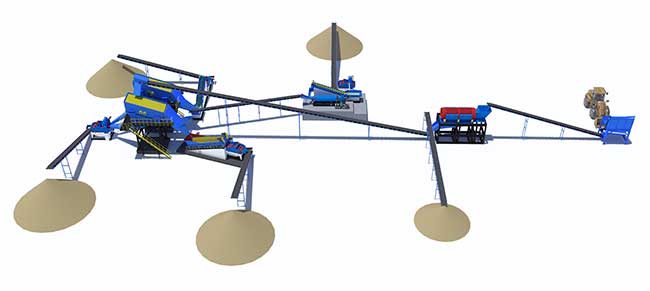
Material moves right to left on the 3D layout, which keeps the conveyor runs short and gives each product pile its own discharge point.
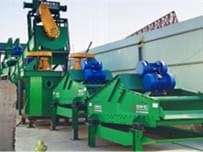
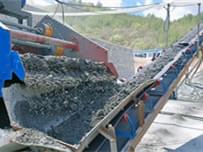
- Feeding. A front-end loader dumps raw sand into a steel hopper with a bar grizzly. A ZZG0930 low-profile vibrating feeder below meters material onto the first belt. The stepped manganese steel bar screen on the discharge end scalps out dirt and fine powder before the material ever reaches the washing section — this is the whole reason we picked the ZZG series over a plain feeder on a sticky feed.
- Scrubbing. Material goes through a GT series rotary screen. The low-speed drum tumbles the feed instead of vibrating it, which actually works for wet, clayey mountain sand that would blind a vibrating screen in ten minutes. High-pressure spray knocks silt off the rock surfaces; oversize is rejected, fines continue.
- Rod milling. A Φ2100 × 3000 rod mill handles the soft weathered rock and rounds off harder pebbles. Rod charge is staged at 110 / 90 / 70 mm. We go with a rod mill here instead of a cone or VSI because soft weathered sandstone wears VSI rotors quickly, and the rod mill does double duty as a scrubber.
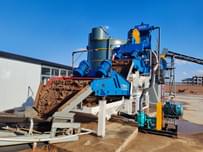
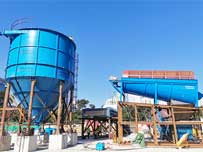
- Sand washing. Washed material drops into a 2LX1500 double spiral sand washer. Twin 1500 mm spirals run through an 8 m tank. Mud goes out with the overflow; clean sand climbs the spirals and discharges at the top. Rated at 120–250 t/h, so it covers the 200 t/h line with headroom.
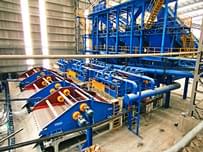
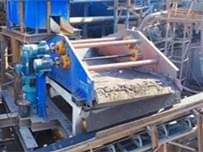
- Screening. A multi-deck vibrating screen sorts washed material into four sizes in one pass. On this site we used a YK series vibrating screen rather than a plain circular screen, because its sloped multi-deck design pushes 40–60% more throughput than the same deck area on a circular screen, and it handles wet feed better.
- Fines recovery. Screen underflow feeds an LZ3048J-140 fines recovery unit: a 3000 × 4800 mm polyurethane dewatering screen with four Φ350 mm hydrocyclones. It pulls back the 0.16–3 mm sand that would otherwise walk out with the slurry. Without it, roughly 10–15% of saleable fine sand ends up in the tailings pond.
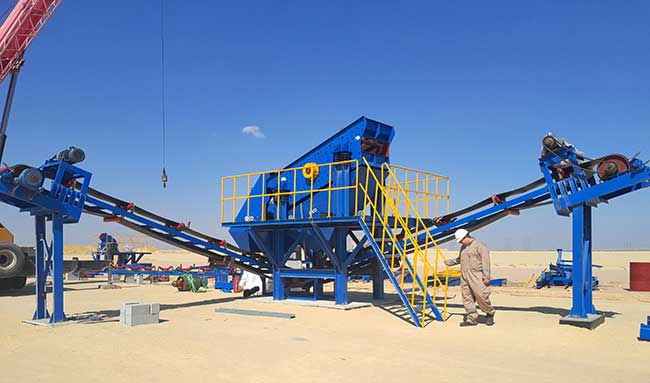
Equipment list (LZZG)
| Equipment | LZZG model | Key specs | Power |
| vibrating feeder | ZZG0930 | 900×3000 mm trough, ≤400 mm feed, 180–260 t/h | 2 × 3.0 kW |
| Rotary screen | WGT2460 | For sticky 25–35% moisture feed, manganese steel mesh | per drum size |
| Rod mill | Φ2100 × 3000 | Rod charge 110/90/70 mm | ~185 kW |
| Double spiral sand washer | 2LX1500 | Φ1500 × 2 spirals, 8000 mm tank, 120–250 t/h | 2 × 22 kW |
| Vibrating screen | YK series | Multi-deck, ≥90% efficiency, 40–60% higher capacity than circular | per deck size |
| Fines recovery unit | LZ3048J-140 | 3000×4800 mm PU screen, 4× Φ350 hydrocyclones, 120–200 t/h | 104 kW |
| Belt conveyors | B800 | Lengths per layout | 7.5–15 kW each |
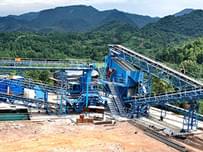
The plant runs in a single straight line: feed on the right, five product piles out on the left. No material backtracks. Conveyor galleries sit on steel trusses high enough to walk under, so an operator isn’t climbing over belts to reach a lubrication point.
Process footprint is about 2,700 m²; closer to 4,000 m² once the water pond, truck access and a small workshop go in.
Expected Product Performance
| Parameter | Target |
| Fineness modulus | 2.6–3.0 (medium sand) |
| Mud content (after washing) | ≤ 3% |
| Fines below 75 µm | ≤ 10% |
| Saleable product yield | 75–80% of feed |
| Specific power consumption | 2.2–2.6 kWh/t |
| Fresh water make-up | ~0.4 m³/t (rest recycled) |
FAQ
How long does it take to deliver and install?
Around four to five months from order: 60–75 days manufacturing, 25–35 days ocean freight, 30–45 days on-site erection and commissioning.
Can this line produce dry mortar grade sand?
The washed 0–5 mm product is close, but dry mortar needs a dryer and packing line, which this layout does not include.
What feed size can it take?
Designed for ≤ 300 mm. Occasional boulders up to 400 mm can pass the ZZG grizzly; anything bigger needs a scalping jaw before the hopper.
What’s the water requirement?
About 60–80 m³/h process water. With closed-loop recycling, fresh make-up is only 10–15% of that.
Why the 2LX1500 and not a wheel washer?
Wheel washers lose a lot of 0.16–3 mm sand to the slurry. The 2LX1500 double spiral holds the fines longer, and we pair it with the LZ3048J-140 recovery unit, so fine sand doesn’t leave with the dirty water.





Send Message
Please write down your requirement and contact details in the following form. You can also send a message to us by this email export@lylzzg.com, we will reply to you within 24 hours.