


Manufactured Sand Standards: 9 Specifications You Need to Know
1. Definition of Manufactured Sand
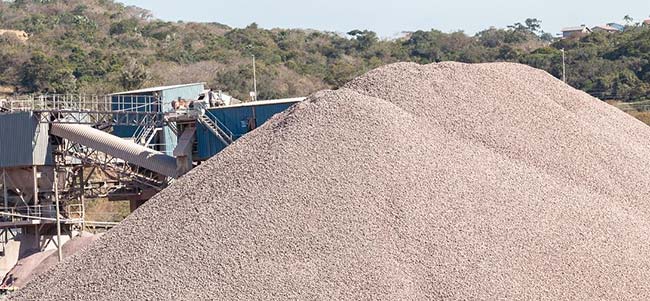
Manufactured sand or M sand, after soil removal, is produced through mechanical crushing and screening processes, with particle size less than 4.75mm, and comes from rock, mine tailings or industrial waste slag particles. It excludes soft and weathered particles and is also commonly known as artificial sand.
2. Grades of Manufactured Sand
The grades of manufactured sand are divided according to the fineness modulus (Mx), specifically divided into 4 types: coarse, medium, fine and extra-fine. The average grain size of manufactured sand varies with different specifications.
Manufactured sand is classified into four categories (coarse, medium, fine and extra-fine) based on fineness modulus (Mx), each with distinct average particle sizes.
| Type of Manufactured Sand | Fineness Modulus (Mx) Range | Average Particle Size Range |
| Coarse sand | 3.7 – 3.1 | > 0.5 mm |
| Medium sand | 3.0 – 2.3 | 0.5 – 0.35 mm |
| Fine sand | 2.2 – 1.6 | 0.35 – 0.25 mm |
| Extra-fine sand | 1.5 – 0.7 | < 0.25 mm |
The larger the fineness modulus, the coarser the sand; The smaller the fineness modulus, the finer the sand.
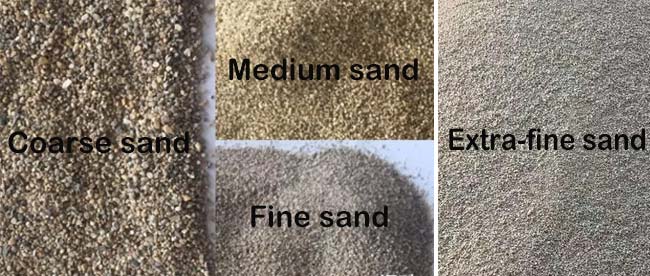
Due to different raw rock sources and varying production equipment and processes, manufactured sand products differ greatly in particle shape and gradation. Nevertheless, any manufactured sand meeting all national standard technical indicators for artificial sand can be applied in concrete and mortar, which is a fundamental difference from natural sand.
3. Quality Classes of Manufactured Sand
Manufactured sand is divided into Class Ⅰ, Class Ⅱ and Class Ⅲ according to performance requirements.
| Quality Class | Application |
| Class Ⅰ Sand | Concrete strength grade > C60 |
| Class Ⅱ Sand | Concrete strength grade C30–C60, frost-resistant, impermeable and other special-performance concrete |
| Class Ⅲ Sand | Concrete strength grade < C30, construction mortar |
4. Technical Requirements for Manufactured Sand
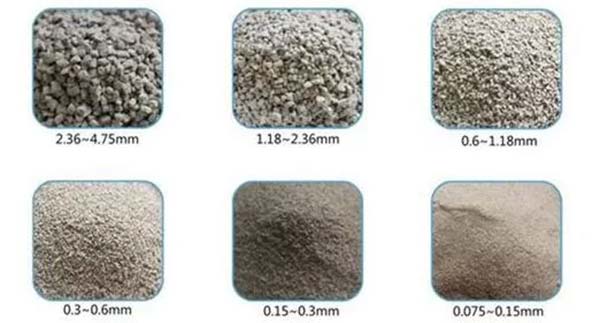
The particle size of manufactured sand ranges from 4.75 mm to 0.15 mm, with a limited proportion of stone fines smaller than 0.075 mm. Standard particle sizes are 4.75 mm, 2.36 mm, 1.18 mm, 0.60 mm, 0.30 mm and 0.15 mm.
Continuous gradation with reasonable proportions of each particle fraction is preferred. Cubic particle shape is ideal, and the content of flaky and elongated particles shall be controlled within specified limits.
5. Particle Gradation of Manufactured Sand
Particle gradation refers to the matching proportion of particles of different sizes in sand, which greatly impacts sand performance.
Sand composed of single-size particles has large internal voids; mixing two or three particle sizes can effectively reduce void ratio. This proves void ratio is closely related to the rational matching of different particle fractions. Reasonable gradation cuts cement consumption and improves the compactness and strength of concrete and mortar.
| Sand Gradation | 0.15mm | 0.30mm | 0.60mm | 1.18mm | 2.36mm | 4.75mm |
|---|---|---|---|---|---|---|
| Coarse Sand | 97~85% | 95~80% | 85~71% | 65~35% | 35~5% | 10~0% |
| Medium Sand | 94~80% | 92~70% | 70~41% | 50~10% | 25~0% | 10~0% |
| Fine Sand | 94~75% | 85~55% | 40~16% | 25~0% | 15~0% | 10~0% |
(Note: All values refer to the cumulative sieve residue percentage, the core technical index to verify whether the particle gradation of manufactured sand meets national standard requirements.)
6. Raw Materials for Manufactured Sand
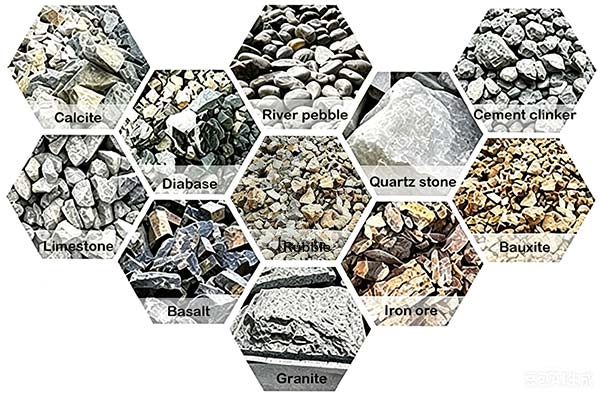
A wide range of raw materials can be used to produce manufactured sand, mainly including granite, basalt and river pebbles. The strength and application of finished manufactured sand vary with rock types after processing.
7. Particle Shape Requirements for Manufactured Sand
The ideal particle shape is cubic or nearly spherical. Compared with flaky, elongated and round particles, cubic grains provide stronger bonding force and larger specific surface area. The content of flaky and elongated particles must be strictly controlled to guarantee the workability and strength of concrete.
| Quality Class | Flaky Particle Content | Applicable Scenario |
| Class Ⅰ Sand | ≤10% | High-strength concrete > C60 |
| Class Ⅱ Sand | ≤15% | C30–C60 concrete |
| Class Ⅲ Sand | ≤20% | Concrete < C30 and construction mortar |
8. Benefits of Manufactured Sand
As a mechanically processed product, manufactured sand features uniform particle size, high rock hardness, high strength, large crystal structure, strong abrasion resistance and stable composition. These merits make it suitable for projects requiring high wear resistance and high structural strength. Concrete mixed with manufactured sand has lower slump and higher 28-day standard compressive strength.
9. Inspection Standards for Manufactured Sand
National standardized test methods are available for M sand. Key test items include appearance inspection, particle size distribution inspection, density inspection, moisture content inspection, etc
| Test Item | Acceptance Requirements | GB/T 14684 Sand for Building) |
| Appearance Inspection | No soil, weeds, tree roots or other debris, uniform particle size, and no clumps of mud; Mud content<2% |
Class Ⅰ (for C60 and above concrete) ≤2.0%; Class Ⅱ (for C30-C55 concrete) ≤3.0%; Class Ⅲ (for below C30 concrete) ≤5.0% |
| Particle Size Distribution | Cumulative passing rate of each sieve ≥90%; fineness modulus stably controlled at 2.4~2.8 |
fineness modulus 2.3~3.0 is defined as medium sand |
| Density | Loose bulk density > 1400 kg/m³ | Minimum requirement ≥1350 kg/m³ |
| Moisture Content | Total moisture content of finished sand < 7% | Requires stable and controllable moisture content |
| Stone Powder Content | Stone powder content < 10% | When MB value ≤1.4 (pure stone powder), Class Ⅰ/Ⅱ sand ≤10%; when MB value >1.4 (containing clay), ≤5% |
| Clod Content | Clod content < 0.5% | Class Ⅰ sand ≤0.2%; Class Ⅱ/Ⅲ sand ≤0.5% |
| Flaky & Elongated Particle Content | Flaky and elongated particle content < 15% | Class Ⅰ sand ≤8%; Class Ⅱ sand ≤15%; Class Ⅲ sand ≤25% |
| Soundness | Mass loss after sodium sulfate cycle test < 5% | Class Ⅰ sand ≤8%; Class Ⅱ/Ⅲ sand ≤10% |
| Crushing Value Index | Crushing value index < 30% | Class Ⅰ sand ≤20%; Class Ⅱ sand ≤25%; Class Ⅲ sand ≤30% |
| Alkali-Aggregate Reaction | No harmful alkali-aggregate reaction, expansion rate < 0.1% |
No alkali-silica reaction No alkali-carbonate reaction hazards |
(Detection of manufactured sand)





Send Message
Please write down your requirement and contact details in the following form. You can also send a message to us by this email export@lylzzg.com, we will reply to you within 24 hours.