


What Are The Reasons For The Low Classification Efficiency Of Hydrocyclones?
The main factors affecting the classification efficiency of hydrocyclones include ore properties, structural factors, and process operation factors. An unreasonable hydrocyclone structure is the primary cause.
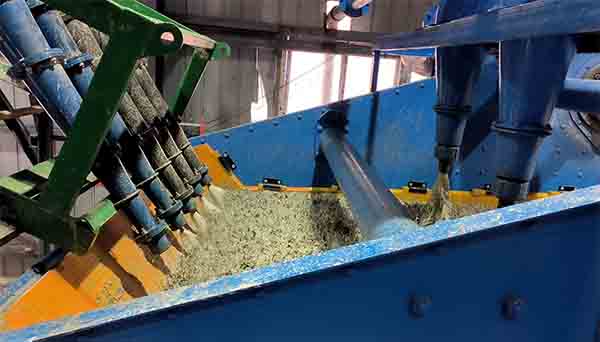
Factors affecting the classification efficiency of hydrocyclones
1. Unreasonable hydrocyclone structure
Structural factors affecting the working efficiency of hydrocyclones include column diameter and height, feed inlet size, underflow nozzle diameter, overflow pipe diameter and depth, and cone angle.
A. Column diameter and height
The diameter of the column determines the separation particle size and production capacity of the hydrocyclone. Hydrocyclone production capacity increases with increasing diameter, and the separated particle size also becomes coarser with increasing hydrocyclone diameter. Therefore, most concentrators select hydrocyclone specifications based on the required overflow particle size, and may even use multiple hydrocyclones in parallel.
The height of the column mainly affects the duration of centrifugal force on the slurry, thus affecting production efficiency. The ideal height of a hydrocyclone column is 0.6-1.0 times its diameter. A taller column results in finer particle size separation. However, if this height exceeds a certain limit, it will lose its effectiveness due to increased feed pressure loss.
B. Underflow nozzle diameter
The appropriate diameter of the settling outlet should allow the settling to be discharged in an umbrella shape, with an included angle of 40°-70°. The ratio of the settling outlet diameter to the overflow pipe diameter is generally 0.4-0.8.
C. Cone angle
The cone angle has a significant impact on the working efficiency of hydrocyclones. A smaller cone angle results in a longer cone body and an increased classification volume, which can enhance the classification process of mineral particles within the hydrocyclone and facilitate the separation of fine materials. When used for fine particle desliming, the cone angle is generally 10°-15°, while for coarse particle classification, the cone angle is generally 20°-45°.
2. Ore properties affect hydrocyclone efficiency
The ore properties include density, particle size distribution, and pulp concentration. Higher ore density results in finer particle size distribution. Higher pulp concentration and mud content increase viscosity and density, increasing particle movement resistance and leading to coarser particle size distribution, and vice versa. Therefore, pre-desliming is necessary when mud content is high.
3. Operating factors affect hydrocyclone efficiency
The main operating factors affecting the efficiency of hydrocyclones include feed, overflow, and sediment discharge. Operators need to improve their skills and maintain all process operating parameters within reasonable ranges to ensure the stable operation of the hydrocyclone.





Send Message
Please write down your requirement and contact details in the following form. You can also send a message to us by this email export@lylzzg.com, we will reply to you within 24 hours.