


3 Factors Affecting The Sorting Efficiency Of Spiral Chute
Factors affecting the sorting efficiency of the spiral chute include the spiral chute structure and performance, ore properties, and spiral chute operation.
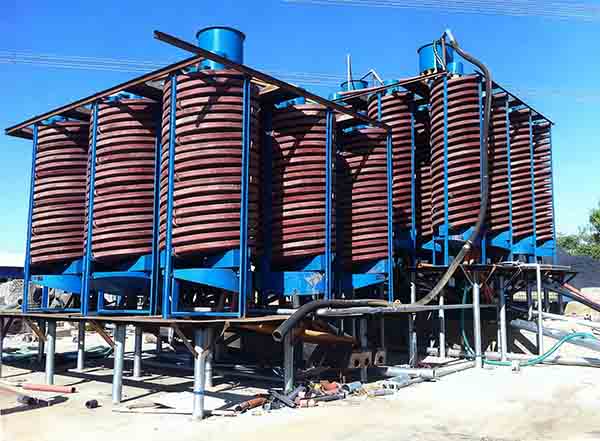
3 Factors affecting the sorting efficiency of the spiral chute
1. Spiral chute structure and performance
A. Spiral chute diameter
The diameter of the spiral chute directly affects the processing capacity and mineral recovery rate. Generally, the larger the diameter of the spiral chute, the larger the mineral flow volume and velocity, and the greater the processing capacity per unit time. Based on practical experience, the smaller the diameter of the spiral chute, the higher the recovery rate.
B. Longitudinal inclination angle of spiral chute
The angle between the tangent to the cross-sectional curve of a spiral chute and the vertical axis is called the longitudinal inclination angle. The larger the longitudinal inclination angle, the faster the slurry flow rate and the greater the centrifugal force on the material. Therefore, a small inclination angle is used when separating fine-grained minerals, and a large inclination angle is used when separating coarse-grained minerals. A suitable longitudinal inclination angle allows the slurry to flow smoothly along the chute, resulting in good mineral processing indicators and improved processing efficiency.
C. Number of turns of the spiral chute
The number of spiral chute turns determines the separation distance and time. In actual operation, it needs to be determined based on the properties of the material and the required performance indicators. When valuable minerals and gangue minerals are closely intercalated and difficult to separate, a larger number of turns is preferable to extend the separation distance and time, thereby improving separation efficiency. However, the number of turns should not be excessive, otherwise it will increase the height of the spiral chute and increase the difficulty of operation. Industrial beneficiation typically uses 4-6 spiral chute turns.
D. Inner surface of spiral chute
The inner surface of the chute must be flat, uniform, and wear-resistant to ensure smooth flow of the slurry. To enhance wear resistance, polyurethane wear-resistant rubber or similar materials are usually coated on the inner surface of the fiberglass spiral chute.
2. Feed ore properties
A. Ore Particle Size
The upper limit for ore particle size fed through the spiral chute is 6mm. Clay minerals require desliming and classification before feeding to prevent material blockage and maintain beneficiation efficiency.
B. Mineral Density
Spiral sluices primarily rely on the density differences between minerals for sorting. Therefore, the greater the density difference between valuable minerals and gangue minerals in the feed ore, the more favorable the sorting process.
3. Operation of the spiral chute
A. Feed volume
The feed volume affects the thickness and velocity of the ore flow. Therefore, to improve efficiency, the feed volume for coarse materials is large, while the feed volume for fine materials is small.
B. Feed concentration
Spiral chutes require a feed concentration greater than 30%. Excessive feed concentration increases slurry viscosity, making the ore layer difficult to loosen, hindering particle settling, severely impacting stratification and particle movement speed, thereby reducing concentrate grade and recovery rate. If the feed concentration is too low, the throughput per unit time will decrease. The mineral bed will become thinner, leading to an increase in slurry flow rate. Useful heavy minerals will be discharged before they have time to separate and settle, thus increasing the tailings grade and reducing the sorting efficiency.






Send Message
Please write down your requirement and contact details in the following form. You can also send a message to us by this email export@lylzzg.com, we will reply to you within 24 hours.