
Overview
What Is A Hammer Crusher
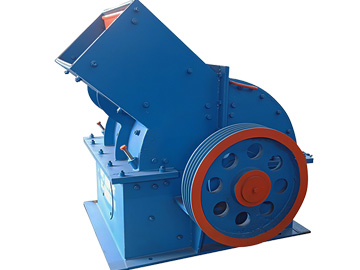
The hammer crusher (PC series) is a high-speed impact machine that breaks material with swing hammers mounted on a rotor. As the rotor turns, the hammers swing outward and strike the feed, which then flies into the breaker plates and grate bars inside the casing and collides with other particles. Material smaller than the grate gap leaves the machine, while oversize pieces stay in the chamber and are struck again, so the rotor and grate together control the final size in one stage.
PC hammer crusher is built for medium-soft, low-abrasion material with compressive strength up to about 200 MPa, rather than hard, high-silica rock. It is common in cement, coal, power generation, chemicals, construction and quarrying, and it works well with limestone, coal, gypsum, chalk and slag. Because it combines crushing and a degree of grinding above the grate, it can replace a two-stage jaw-and-secondary setup on suitable feed.
Main Parts and Wear Components
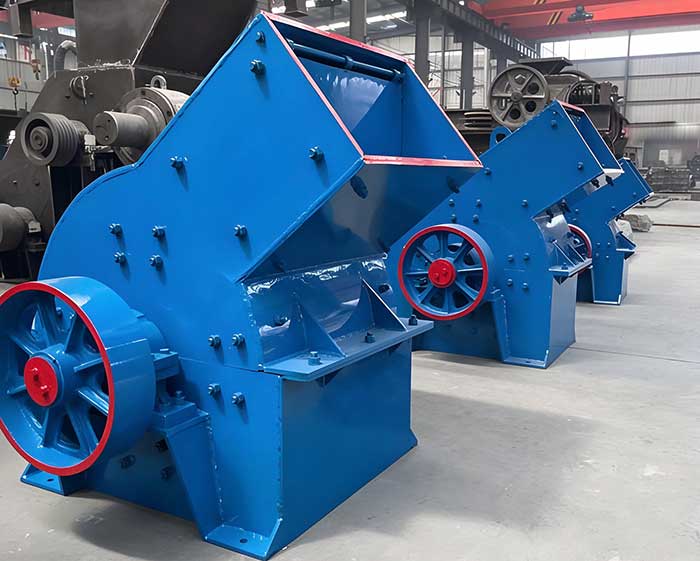
The main assemblies are the casing, the rotor, the swing hammers, the breaker plates or liners, the grate bars and the drive. The hammer heads and grate bars carry most of the wear and are designed for replacement, and the hammers are pinned to the rotor so they can swing back if an uncrushable object enters. The gap between the rotor and grate, and the spacing of the grate bars, set the discharge size.
How It Differs From an Impact Crusher
- Both hammer crushers and impact crushers use impact, but the hammer crusher relies on swing hammers and a bottom grate, while the impact crusher uses rigidly fixed blow bars and multiple impact plates.
- The impact crusher handles harder material up to about 350 MPa and gives a stronger cubical shaping effect, while the hammer crusher is the lower-cost choice for medium-soft rock such as limestone and coal.
- On abrasive, high-silica feed, hammer heads wear quickly and a cone or jaw crusher is often more economical, so feed hardness and abrasiveness should drive the decision.
-
Working principle
High-Speed Impact and Collision
The motor drives the rotor through belts, and the hammers strike the incoming material at high speed. The broken pieces gain kinetic energy from the hammers and rush toward the baffle and breaker plates inside the frame, while particles also collide with each other. Size reduction therefore comes from direct hammer impact, collision with the liners and particle-to-particle impact rather than compression.
Grate-Controlled Discharge
Particles smaller than the gaps in the grate bars pass through and leave the machine, while larger particles remain above the grate and are struck and ground again until they can pass. Keeping the feed moisture low prevents the grate from clogging, and the swing-back action of the hammers gives some protection when uncrushable material enters.
-
Features & Benefits
1. One-stage reduction. Impact plus grinding above the grate can replace two stages on medium-soft feed.
2. Controlled product size. The grate bars hold a consistent discharge limit without extra screens.
3. Simple, compact structure. The machine is straightforward to install and operate.
4. Low investment. A single unit and limited wear parts keep capital and running cost down.
5. Versatile feed. It handles limestone, coal, gypsum, chalk, salt and brick, and can be mobile or stationary.
6. Easy maintenance. Hammer heads and grate bars are replaced quickly through the casing.
-
Specifications
Model Feed Size (mm) Discharge Size (mm) Capacity (m³/h) Power (kW) Total Weight (t) Overall Dimensions (L×W×H) (mm) PC400×300 <100 0-10 3-8 11 0.5 855×795×860 PC600×400 <220 0-20 8-15 18.5-22 1.6 1150×1095×1230 PC800×600 <350 0-25 15-45 45 4 2360×1490×1415 PC1000×800 <400 0-25 40-60 75 6.5 3072×1720×2121 -
Inquiry
Please write down your requirement and contact details in the following form. You can also send a message to us by this email export@lylzzg.com, we will reply to you within 24 hours.







Inquiry