


3 Common Faults And Solutions Of Sand Washing Machines
The three most common malfunctions of sand washing machines are stator and rotor core failures, bearing wear, and shaft failures. These malfunctions affect the production efficiency and output of the sand washing line. The following section describes solutions to these problems.
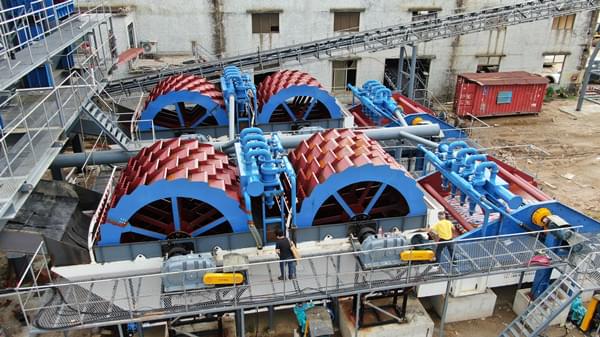
3 Common faults and solutions of sand washing machines
1. Stator and rotor core faults
The stator and rotor, made of stacked, mutually insulated silicon steel sheets, form the magnetic circuit of the electric motor. Damage and deformation of the stator and rotor cores are mainly caused by the following factors.
A. Excessive bearing wear or improper assembly can cause friction between the stator and rotor, damaging the surface of the iron core and leading to short circuits between silicon steel sheets. This increases the iron losses in the motor and causes excessive temperature rise. In this case, use a fine file or similar tool to remove burrs, eliminate the short circuits between the silicon steel sheets, clean the motor thoroughly, apply insulating varnish, and then heat and dry it.
B.The iron core surface is corroded due to moisture and other reasons. After cleaning with sandpaper, apply insulating varnish.
C.The high heat generated can burn out the iron core grooves or teeth. The molten material can be removed with tools such as chisels or scrapers, and then coated with insulating varnish and dried.
D.If the connection between the iron core and the base is loose, tighten the original positioning screws. If the positioning screws are ineffective, re-drill positioning holes on the base, tap threads, and tighten the positioning screws.
2. Bearing wear
The shaft rotates via bearings and is a component prone to wear. Slight noise may occur when there is sand or other debris inside the bearing or when the bearing parts are slightly worn. Rust spots on the outer surface of the bearing can be removed with sandpaper, then cleaned in gasoline. If the bearing has cracks, broken inner or outer rings, or excessive wear, it should be replaced with a new bearing. When replacing with a new bearing, select one of the same model as the original.
3. Shaft failure
Shaft bending: If the bending is minor, it can be repaired by grinding the journal and slip ring. If the bending exceeds 0.2mm, the shaft can be placed under a press and pressure applied to the bent area for straightening. The straightened shaft surface should then be machined and ground on a lathe. If the bending is too severe, a new shaft must be replaced.
Previous:Comparison Of Sand Washing Machine Models For Sale
Next:none





Send Message
Please write down your requirement and contact details in the following form. You can also send a message to us by this email export@lylzzg.com, we will reply to you within 24 hours.